

HomeNEW REPUBLIC.Decades of war paid...

Decades of war paid off with new national symbols

Independence is days away, but the sentimental mood of independence is slowly gripping the nation, with hundreds of volunteers across the country teaching others to memorize the national anthem, report DANIEL DENG BOL & JOSEPH EDWARD:


“I feel, in my heart, drops of tears when I sing it,” Cirino Hiteng Ofuho, minister in the office of the Presidency said last week. “This nation would have been born fifty years ago, but now it is going to be born in our time.”
The minister said he would sing the anthem before bedtime to keep it fresh in his memory.
Huriya Amani John, 28, a resident in Juba told New Times that anthem means freedom for him.
“I feel extremely happy and the at the same time emotional when I sing it because this time we people of Southern Sudan have been granted freedom”.
John was born in 1983, the same year as the Sudan People’s Liberation Army took up ups to fight the north.
“I knew what was happening during the war,” John says. “I almost shed tears when I sung it and when I hear people sing it.”
Samuel Garang Akot did not know the anthem, but he was curious to learn to sing it.
“I feel good and comfortable when practicing singing this song,” Akot said. “Having a national anthem is an indication that South Sudan is going to get its real independence; and we would love to have our own national anthem where we can easily express our happiness.”
Even Brigadier General Malaak Ayuen, director of Information at the Sudan People’s Liberation Army, was excited, despite spending a year helping to construct the anthem.
Ayuen said he was happy.
“South Sudan is at the verge of becoming a nation,” he said.
The clock is ticking to independence and the time does not seem enough to do it all.
Sudan People’s Liberation Army General Headquarters is planning to produce CDS of the national anthem.

Instruments of Power

The CDs will contain the name of the country, Coat of Arms, and flag. And they would have a summary of the history of the war that led to self-determination.
“So we are going to embrace this song in our heart and in our mind because by the 9th of July everybody should be in position to sing the national anthem,” Ayuen said last week. The national anthem will also be printed out for people to read.
Malaak says the flag of the Republic of South Sudan, and the Coat of Arms will be bestowed upon the President as “instruments of powers”.
And, the national anthem, Malaak says, will be scripted in a golden plated frame and handed over to the President of the Republic of South Sudan Salva Kiir Mayardit as sign of honor and symbol of unity for the people of South Sudan, New Times has learnt from officials.
The South Sudan national anthem was selected following public contests.
South Sudanese musicians, academicians, and expert writers devoted months to come up with what they figured would be the best pieces for the national anthem.
In all 49 poems were received and students of art and music at Juba University emerged winners.
South Sudan national anthem has three stanza which tell difference meaning, the first stanza is dedicated to God , second was dedicated to the great patriots while the third dedicated to the people of the land, and the great patriots whose their blood cemented the nation foundation technical committee expert had narrated.

A National Identity

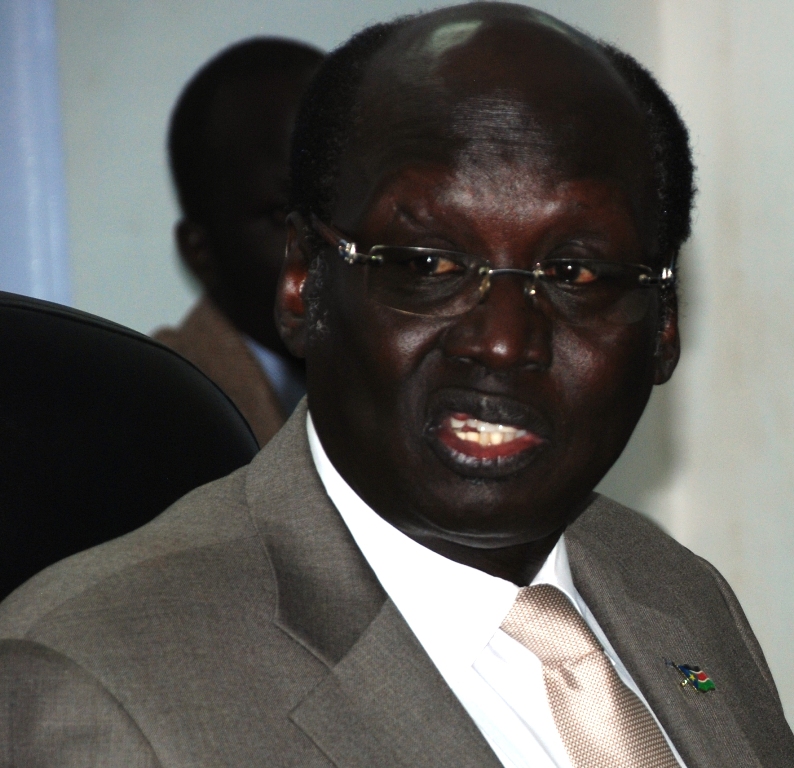
To Information Minister Barnaba Marial Benjamin the anthem will unite the people of Southern Sudan, as it reflects the identity of its citizens, unlike the old Sudan Anthem.
The anthem comprise of three stanzas.
The Oh God reflects the belief of the people of South Sudan in God.
Oh, motherland reflects the land for which the people struggled for the 55 years since the independence of the Sudan in 1956.
Great Patriots honors the lost heroes and heroines of Southern Sudan during the struggle.
Marial said the people of South Sudan are proud when singing the Anthem, because they know the price of independence – a war that claimed more than 2.5 million lives.
On Independence Day, Marial said, “We need to teach our brothers to enable everybody sing the anthem without reading from the paper.”
The minister said the Republic of South Sudan would be born with its anthem unlike other countries.
“Many African countries got independence without an Anthem,” Marial said. “We are lucky.”

- A word from our sponsors -

sponsored: GRE. GMAT. TOEFL. IELT CLASSESspot_img

Most Popular

More from section

More Courage Than Before: Female Monitors Strengthening Early Warning Systems in South Sudan

Simona Ali, an Early Warning Monitoring Fellow from Wau, says the fellowship created a space for female journalists to share experiences and learn from each other. By passing this knowledge on to colleagues in her newsroom, she is helping strengthen awareness of journalist safety and professional rights

Speaking Up for Rights: Female Monitors Strengthening Early Warning Systems in South Sudan

Catherine Adut, an Early Warning Monitoring Fellow from Lakes State, says the fellowship helped her understand her rights and speak up against unfair treatment. Today, she encourages other female journalists to report harassment, defend their rights, and support one another in the newsroom.

Confidence to Stand Up: Female Monitors Strengthening Early Warning Systems in South Sudan

Viola Nyoka, an Early Warning Monitoring Fellow from Yei, says the fellowship helped her understand the risks female journalists face and the importance of speaking up. Through shared experiences with colleagues across South Sudan, she gained the confidence to challenge exploitation, report harassment, and stand up for her rights in the newsroom.

Knowing Where to Turn: Female Monitors Strengthening Early Warning Systems in South Sudan

Vivian Nandege, an Early Warning Monitoring Fellow from Yei, says the fellowship helped her understand where to seek support when facing challenges in journalism. Through connections with other female journalists, she has gained confidence, shared knowledge, and built a stronger professional network.

- A word from our sponsors -

spot_img

Read Now

More Courage Than Before: Female Monitors Strengthening Early Warning Systems in South Sudan

Simona Ali, an Early Warning Monitoring Fellow from Wau, says the fellowship created a space for female journalists to share experiences and learn from each other. By passing this knowledge on to colleagues in her newsroom, she is helping strengthen awareness of journalist safety and professional rights

Speaking Up for Rights: Female Monitors Strengthening Early Warning Systems in South Sudan

Catherine Adut, an Early Warning Monitoring Fellow from Lakes State, says the fellowship helped her understand her rights and speak up against unfair treatment. Today, she encourages other female journalists to report harassment, defend their rights, and support one another in the newsroom.

Confidence to Stand Up: Female Monitors Strengthening Early Warning Systems in South Sudan

Viola Nyoka, an Early Warning Monitoring Fellow from Yei, says the fellowship helped her understand the risks female journalists face and the importance of speaking up. Through shared experiences with colleagues across South Sudan, she gained the confidence to challenge exploitation, report harassment, and stand up for her rights in the newsroom.

Knowing Where to Turn: Female Monitors Strengthening Early Warning Systems in South Sudan

Vivian Nandege, an Early Warning Monitoring Fellow from Yei, says the fellowship helped her understand where to seek support when facing challenges in journalism. Through connections with other female journalists, she has gained confidence, shared knowledge, and built a stronger professional network.

Strengthening Professional Networks: Female Monitors Strengthening Early Warning Systems in South Sudan

Cecilia John Akile, an Early Warning Monitoring Fellow from Wau, says the fellowship helped her build stronger professional connections with journalists across South Sudan. Through the network, she has learned the importance of speaking openly about challenges and collaborating with colleagues to find solutions

Standing Firm Under Pressure: Female Monitors Strengthening Early Warning Systems in South Sudan

Assunta Aluel, a journalist from Twic County, says the Monitoring Fellowship helped her remain calm and professional when she faced questioning after reporting a sensitive community story. The training equipped her with the confidence and knowledge to navigate pressure while continuing her work.

Building Stronger Connections: Female Monitors Strengthening Early Warning Systems in South Sudan

Aleng Vicky, an Early Warning Monitoring Fellow from Torit, says the fellowship helped female journalists across Eastern Equatoria connect and share experiences. Through new communication platforms and peer discussions, women journalists are building stronger networks and supporting each other in the profession.

From Connection to Courage: Female Monitors Strengthen Early Warning Systems in South Sudan

"At the back of your mind, when covering news, you must remember there are things you must follow while doing this. That has instilled more confidence in us than before." - ARICH DENG

Forging a Lifeline: Female Monitors Power Early Warning Systems in South Sudan

An early warning system fellowship empowers frontline monitoring fellows to detect risks early, trigger rapid response, and strengthen protection support for those facing threats.

The Mic Was Silenced: A Young Female Journalist Struggles to Reclaim the Airwaves in South Sudan

They shut it down after a song—just a traditional tune from the wrong community—played during a flare-up in local fighting. Officials stormed in, seized the keys, and warned the staff: One more mistake, and the whole station is gone for good. For a moment, Achol was jobless...

 “If You Don’t Have the Heart for It, You Can’t Carry On”

As a child, she fled bombings by the Sudanese government and attacks by the Ugandan rebel Lord’s Resistance Army, living a refugee live in DR-Congo, CAR, and Uganda. As a woman, she faced down militias. Today, she stands at the frontline of media freedom in Western Equatoria...