
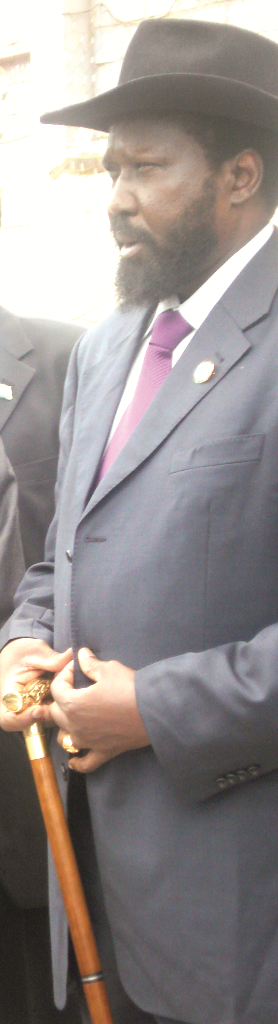
“At this time, it is good to have an executive with small size of ministers so that we can deliver basic services to our people. There is a thinking that we need to have fewer ministries. If it is about 25 or less, I think it can be a lean government.”
MABIOR PHILIP MACH
They were up in arms when the transitional Constitution recommended expanding the size of Parliament. And, now, Members of Parliament are up in arms in support of the President’s call for a lean Cabinet.
In saying that he would name a lean Cabinet, President Salva Kiir was not alone, according to interviews by New Times, revealing that Members of Parliament also silently hoped for an inclusive, yet small-sized Cabinet in what they said was meant to enable the national government to spare the cash in order to deliver services.
The Government of Southern Sudan had 32 ministers. The large size of the Cabinet at the time, legislators told New Times, was meant to accommodate rivaling politicians, yet it drained money and impaired the vision of taking towns to the people.
“At this time, it is good to have an executive with small size of ministers so that we can deliver basic services to our people,” said Banguot Amum Okiech, the Government Chief Whip. “There is a thinking that we need to have fewer ministries. If it is about 25 or less, I think it can be a lean government.”
But days after Independence, the President faced more lobbying as politicians who had been operating in the north all returned, with many lobbying for Cabinet seats. According to reports, an estimated 500 politicians eyed ministerial portfolios.
“I want to see a government that is sizeable in number; that can deliver,” said Mabaan County representative David Unyo Demey. Demey says he prefers a Cabinet below 30.
“We want to use the resources we have now to implement the vision of our late leader John Garang of taking towns to the people,” he said. “Others think the government can accommodate everyone. I don’t think that it is right.”
The MP said the people ought to be patient to allow time with a manageable Cabinet.
“The number of 32 ministers was very high,” Tongun Lodu says. “If the president can bring the number down to 18 it is very good. It cannot represent every tribe but parties are the best.”
Tongun was hoping that the President would be ware of officials who do not account for how they manage government funds or projects. Tongun also said the President ought to announce his appointments when the Assembly is in session. That would always give legislators chance to vet and throw out non-trustworthy appointees.
“Basically, it is good to have a lean government rather than a big government,” said Andrew Okuny Ayom, the Opposition Chief Whip. “A lean government can be broad-based. It doesn’t mean everybody has to go into the government because it cannot take all. Others can wait.”
But the opposition leader also said all Parties were hoping to be brought on board. Ayom said only the sovereign ministries ought to be shared according to regional grouping.
When Parliament reopens, in August, the president, according to the Transitional Constitution of South Sudan 2011, will appoint 66 members across the political divide and the civil society to the National Assembly.
“This time now, we thought there should have been more opposition in the parliament because it is a transitional government,” Okuny said.
New Parliament to have 229 MPs
BY JOSEPH EDWARD
President Salva Kiir will name sixty six more members of Parliament from all South Sudan political parties to add on the elected members, the of opposition in South Sudan Legislative Assembly Onyoti Adigo has said.
Next Parliament will also include 93 MPs formerly representing the South in the Northern Parliament, and 170 current MPs to make Parliament at least 229. This means that each state would have nearly double its current representation in Parliament.
MPs are on leave until August 29, and that, some MPs suggested last week, would have meant that the President would wait until then before he named a caretaker Cabinet.
A Presidential directive that caretaker ministers can not take major decisions has fuelled the recent furor that the President would announce his Cabinet soon, some observers say.
When he named a caretaker Cabinet two weeks ago, President Salva Kiir said the ministers could not take major policy decision. This was in the decree the President passed naming a caretaker government, and reconfirming Presidential Advisors pending final reorganization of the government.
The Advisors are Lual Diing Wuol Advisor for Political Affairs, John Koung Nyoun Advisor for Security Affairs, Madam Rebekah Nyandeng De Mabior Advisor on Gender and Human Rights, Telar Riing Deng Advisor on Legal Affairs, and Alfred Lodu Gore Advisor on Diplomatic Affairs.
Advisors also include Tor Deng Mawein Advisor on Decentralization and Intergovernmental Linkages, Salva Mathok Gengdit Advisor on Military Affairs, Cornelius Befo Advisor on Monitoring and Integrity in Governance.
Also included are Col. Sidig El Manas Basil on Southern Blue Nile ,Chief Kong Kong Bol Advisor on Inter Communal Peace, Joseph Lagu Yanga Special Advisor, Dr.Martin Elia Lomuro Advisor on Public Affairs, General Kennedy Gen. Ngery Inter communal Peace and Traditional Leadership Affairs, Chief Tem Kok Ngor Advisor on Inter border conflict and Traditional Leadership Affairs.
The list also had Dr. Joseph Montueyl Wejang Advisor on Social Services, Rev. Tijowk Hadher Agwet Advisor on Religious Affairs, Isaiah Kulang Mabor Special Advisor for Wild Life and Tourism and Gissmallah Abdallah Rasas Special Advisor to The President.
Akor Kur is new internal security chief
BY OWEN BOSCO
The decree dissolving the security agencies, including Special Branch under the Presidency, Public Security under the ministry of Interior, and elements of National Intelligence requires them to report to the Army General Headquarters for re-assignment; Public Security officials are to report to the Inspector General of Police with immediate effect.
Major General Thomas Duoth Guet is Director General for External Security and Brigadier General Akol Kur Koch is Director General for Internal Security.
Major General Thomas Duoth Guet was formerly head of the Special Branch while Lieutenant General Majak Agot was the deputy head of the National Security and Intelligence Service, and head of its southern component.
Anti-corruption body seeks protection for whistleblowers
BY MOI PETER JULIUS
The Anti-Corruption Commission (NACC) wants laws enacted to protect whistleblowers.
“If there is no protection, people fear to give vital information in fear for their lives. Even staff within the commission needs protection too,” said Francis Bansan, the director general for state coordination and donor relations, in an interview with the New Times.
He said that the Commission now has a mandate to prosecute suspected corrupt officials under the Transitional constitution for the Republic of South Sudan.
The NACC is an autonomous and impartial body corporate established under Section 147 of the Interim Constitution of Southern Sudan, 2005 as read with Section 6 of the Southern Sudan Anti-Corruption Act, 2009.
The Commission has a mandate, inter alia, to protect public property and investigate cases of corruption with a view to protecting public property as well as in the private sector and combating administrative malpractices in public institutions.
South Sudan flag hoisted at AU in Addis Ababa
BY A CORRESPONDENT
The flag of the Republic of South Sudan has been hoisted at the African Union Headquarters in Addis, following admission to the continental body.
RSS is AU’s 54th member.
The Addis Ababa-headquartered organisation Wednesday said it had accepted an official request for membership from the Southern Sudan government.
The membership is in line with the AU’s constitutive act, the club said in a statement, adding that the decision had been circulated to all member states and international organisations.
An official welcoming ceremony will be held as soon as possible in consultation with Juba, it further said. South Sudan’s flag has already been hoisted at the AU’s compound to recognise the newly-born member state.
Southern Sudan declared independence on July 9 following a week-long referendum in January that overwhelmingly voted for secession from the North.