

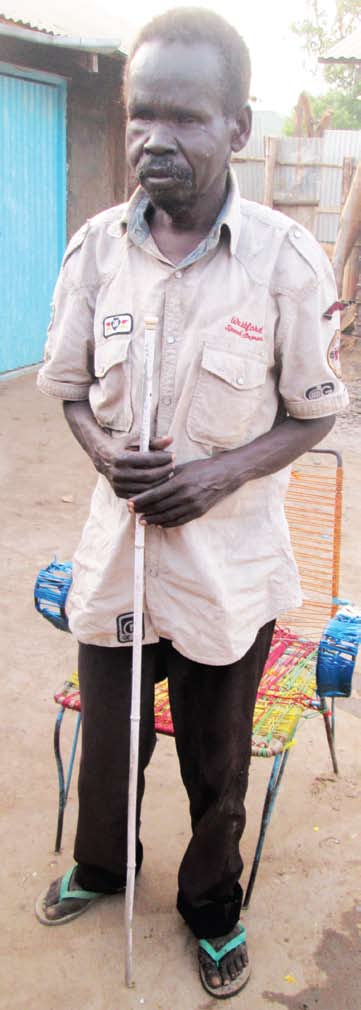
HomeLIVING IN SOUTH SUDANGrateful blind beggar. Thank...

Grateful blind beggar. Thank you Lord for what you have given me today

BY MORRIS DOGGA LUWO LOGODO

Tapping his metallic walking stick on the ground, Paulino Laku Michael, 59, exits his zinc and iron house, as his two children Emmanuel Paulino, 15, and Michael Paulino, 8, wash their legs in preparation for school.
“Is it not coming to rain?” Laku asks.
“No, the sky is clear,” Emmanuel answers.
The sons enter the house. Laku re-appears from the back of the house.
“We are now going to school” says Michael as he exits the house in a school uniform.
After the sons have left, Laku picks up his stick, taps the ground to find the chair where he is supposed to sit. His wife, Grace Gire, brushes her teeth at the corner of the house.
Minutes later, Laku picks his walking stick, exits the gate as the wife, Grace Gire, also sets off for Suk Melishia, a market about half a kilometer away.
He almost walks into a bam- boo fence as he steps into the gravel road outside his home. Occasionally, he senses some- one walking beside him. His hand out stretched, he murmurs: “Saidu al meskin (help the poor).”
The man, walking with two children in blue shorts and white shirts, presumably headed to school, drops a 5 pound (10 US cents) note into Laku’s hands.
“Thank you very much,” Laku says as he places the money into his trousers pocket. “May God bless you.”
At one point, he steps into black, stagnant water from a bathing shelter that channels into the road.

With the help of people of good will, 30 minutes later, Laku reaches Lybia market, a half a kilometer from his home.
“Saidu al meskin”
“Go away,” says a woman selling tea at the market. “Don’t disturb people in the morning like this.”
Laku ignores the woman, taps the ground to find a place to sit.
He settles on the stairs at the entrance to a shop, holding his cheeks.
Every now and then someone drops money into his hand.

NOT ALWAYS BLIND

Born in 1957, Paulino was not always blind. “I became blind when I was 20 years” he says. “Before I became blind, I was doing everything for myself.”
His eyes are teary cheeks.
Growing up with his parents in Dolo payam of Rokon, Laku’s education was cut short when his eye problems started. He was 20 and had just completed high school. “Some white, sticky liquids started coming out from my Eye,” Laku says, “I stayed in the Chinese Hospital for six months, but nothing changed.”
Laku stayed with the sister Bulluk, but when the sister mar- ried and moved to Rejaf, Laku was left alone. There was no one to cook or take care of him. He decided to go begging. Some people would give him food stuffs; others would give him money.
Laku recalls that first day, in 1995. It was not easy. “The first day I went to beg, I got only 3 [dinar],” he says. “But I didn’t give up.”
He met his wife in 1997. The wife was also half-blind.
Every day, they both go sepa- rate ways to beg.

RAINY DAY
As for now, begging seems the only way Paulino and his family is surviving from. “If I don’t go to the street and beg, my family does not eat,” he says. Cheeks in his palm, he falls silent for a couple of minutes.
It’s not always easy. One day last year, when he and his wife did not go out to the street to beg, the family went to bed hun- gry. The worst times are when the rains come. “When it rains, I get small amount” he says “I can’t move to faraway places.”
He’s lucky, today it didn’t rain. At around 4:00pm, Paulino sets walking stick left and right as he struggles to find his way.
“Go this way,” a man selling timbers directs him.
Laku has hardly walked for two minutes when his son, Emmanuel, comes looking for him.
“It’s me, your son,” Emmanuel says as he holds his father’s walking stick. “I have come to look for you”.
He empties his pockets and places the money into Emmanuel’s hands. “You count this money,” he tells the son.
“It’s 30 pounds,” the son replies after counting.
“Thank you Lord for what you have given me today,” Laku says, his left hand stretched out to the
sky. “Today is a better day” he says. “Take me quickly home so you can go back to the market to buy maize floor and dagga fish for us.”

- A word from our sponsors -

sponsored: GRE. GMAT. TOEFL. IELT CLASSESspot_img

Most Popular

More from section

More Courage Than Before: Female Monitors Strengthening Early Warning Systems in South Sudan

Simona Ali, an Early Warning Monitoring Fellow from Wau, says the fellowship created a space for female journalists to share experiences and learn from each other. By passing this knowledge on to colleagues in her newsroom, she is helping strengthen awareness of journalist safety and professional rights

Speaking Up for Rights: Female Monitors Strengthening Early Warning Systems in South Sudan

Catherine Adut, an Early Warning Monitoring Fellow from Lakes State, says the fellowship helped her understand her rights and speak up against unfair treatment. Today, she encourages other female journalists to report harassment, defend their rights, and support one another in the newsroom.

Confidence to Stand Up: Female Monitors Strengthening Early Warning Systems in South Sudan

Viola Nyoka, an Early Warning Monitoring Fellow from Yei, says the fellowship helped her understand the risks female journalists face and the importance of speaking up. Through shared experiences with colleagues across South Sudan, she gained the confidence to challenge exploitation, report harassment, and stand up for her rights in the newsroom.

Knowing Where to Turn: Female Monitors Strengthening Early Warning Systems in South Sudan

Vivian Nandege, an Early Warning Monitoring Fellow from Yei, says the fellowship helped her understand where to seek support when facing challenges in journalism. Through connections with other female journalists, she has gained confidence, shared knowledge, and built a stronger professional network.

- A word from our sponsors -

spot_img

Read Now

More Courage Than Before: Female Monitors Strengthening Early Warning Systems in South Sudan

Simona Ali, an Early Warning Monitoring Fellow from Wau, says the fellowship created a space for female journalists to share experiences and learn from each other. By passing this knowledge on to colleagues in her newsroom, she is helping strengthen awareness of journalist safety and professional rights

Speaking Up for Rights: Female Monitors Strengthening Early Warning Systems in South Sudan

Catherine Adut, an Early Warning Monitoring Fellow from Lakes State, says the fellowship helped her understand her rights and speak up against unfair treatment. Today, she encourages other female journalists to report harassment, defend their rights, and support one another in the newsroom.

Confidence to Stand Up: Female Monitors Strengthening Early Warning Systems in South Sudan

Viola Nyoka, an Early Warning Monitoring Fellow from Yei, says the fellowship helped her understand the risks female journalists face and the importance of speaking up. Through shared experiences with colleagues across South Sudan, she gained the confidence to challenge exploitation, report harassment, and stand up for her rights in the newsroom.

Knowing Where to Turn: Female Monitors Strengthening Early Warning Systems in South Sudan

Vivian Nandege, an Early Warning Monitoring Fellow from Yei, says the fellowship helped her understand where to seek support when facing challenges in journalism. Through connections with other female journalists, she has gained confidence, shared knowledge, and built a stronger professional network.

Strengthening Professional Networks: Female Monitors Strengthening Early Warning Systems in South Sudan

Cecilia John Akile, an Early Warning Monitoring Fellow from Wau, says the fellowship helped her build stronger professional connections with journalists across South Sudan. Through the network, she has learned the importance of speaking openly about challenges and collaborating with colleagues to find solutions

Standing Firm Under Pressure: Female Monitors Strengthening Early Warning Systems in South Sudan

Assunta Aluel, a journalist from Twic County, says the Monitoring Fellowship helped her remain calm and professional when she faced questioning after reporting a sensitive community story. The training equipped her with the confidence and knowledge to navigate pressure while continuing her work.

Building Stronger Connections: Female Monitors Strengthening Early Warning Systems in South Sudan

Aleng Vicky, an Early Warning Monitoring Fellow from Torit, says the fellowship helped female journalists across Eastern Equatoria connect and share experiences. Through new communication platforms and peer discussions, women journalists are building stronger networks and supporting each other in the profession.

From Connection to Courage: Female Monitors Strengthen Early Warning Systems in South Sudan

"At the back of your mind, when covering news, you must remember there are things you must follow while doing this. That has instilled more confidence in us than before." - ARICH DENG

Forging a Lifeline: Female Monitors Power Early Warning Systems in South Sudan

An early warning system fellowship empowers frontline monitoring fellows to detect risks early, trigger rapid response, and strengthen protection support for those facing threats.

The Mic Was Silenced: A Young Female Journalist Struggles to Reclaim the Airwaves in South Sudan

They shut it down after a song—just a traditional tune from the wrong community—played during a flare-up in local fighting. Officials stormed in, seized the keys, and warned the staff: One more mistake, and the whole station is gone for good. For a moment, Achol was jobless...

 “If You Don’t Have the Heart for It, You Can’t Carry On”

As a child, she fled bombings by the Sudanese government and attacks by the Ugandan rebel Lord’s Resistance Army, living a refugee live in DR-Congo, CAR, and Uganda. As a woman, she faced down militias. Today, she stands at the frontline of media freedom in Western Equatoria...