

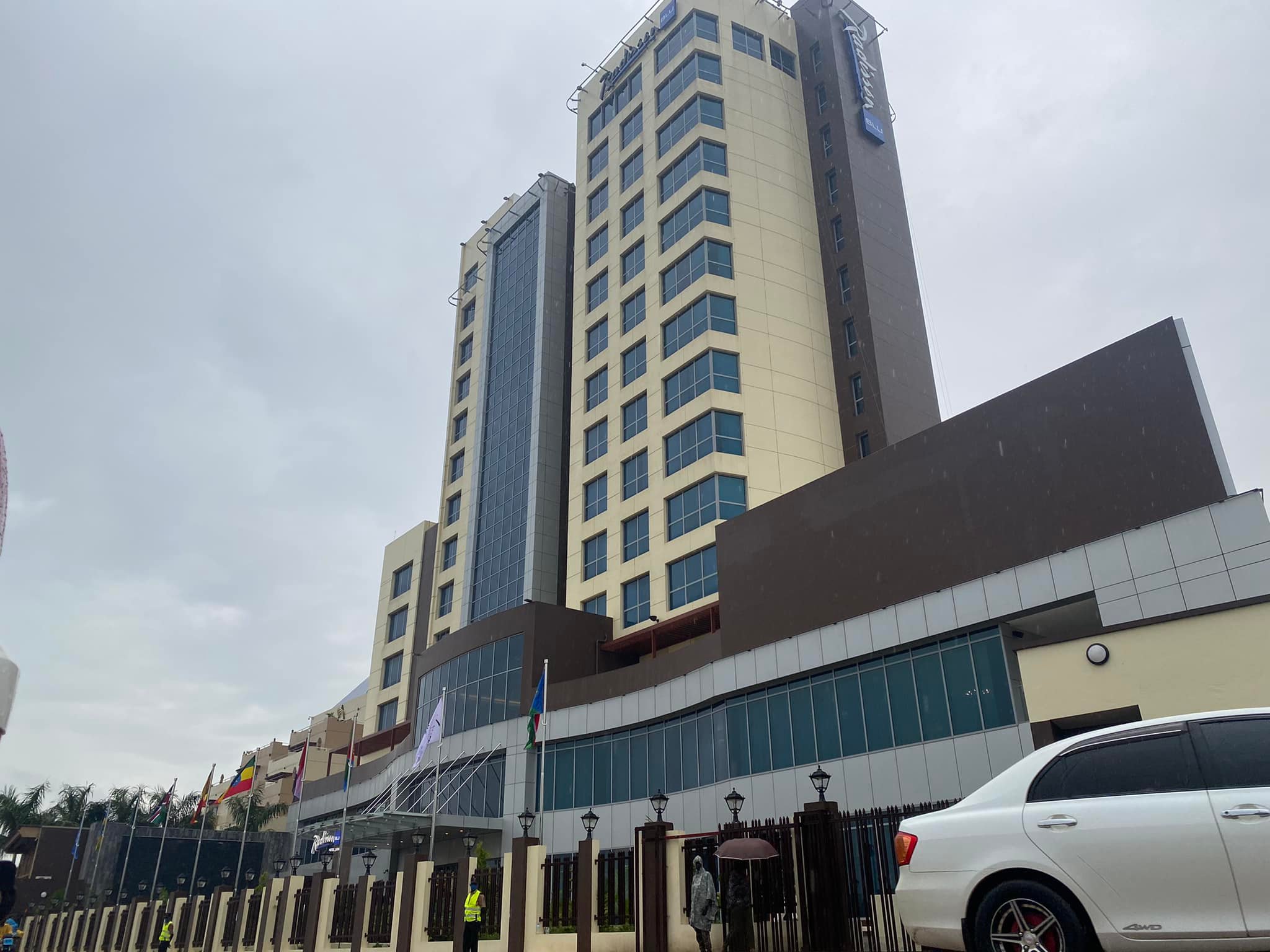
Do You Know Who I’m? In Bouncing Gatecrashers, Radisson Blu Debuts Juba With Bold Security Statement

Arriving in a white Toyota land cruiser accompanied by two lady companions in marching orange suits, a top official summons Juba’s first internationally branded 5-star, 154-roomed hotel that offers views of the city, the famed White Nile River, and the pool, to his car.

“I am from the ministry of wildlife and tourism; I want to leave these women here and join them later,” he says.

A Radisson Blu guard, helped by the hotel staff, skims the guest list to confirm.

The ladies alight from the car, their eyes gazing in admiration at the newest hotel to grace this skyline, and lean against the shiny marble perimeter wall, engaging in banter to pass time.

“You remember this area used to be a natural toilet before the independence of South Sudan,” one lady says.
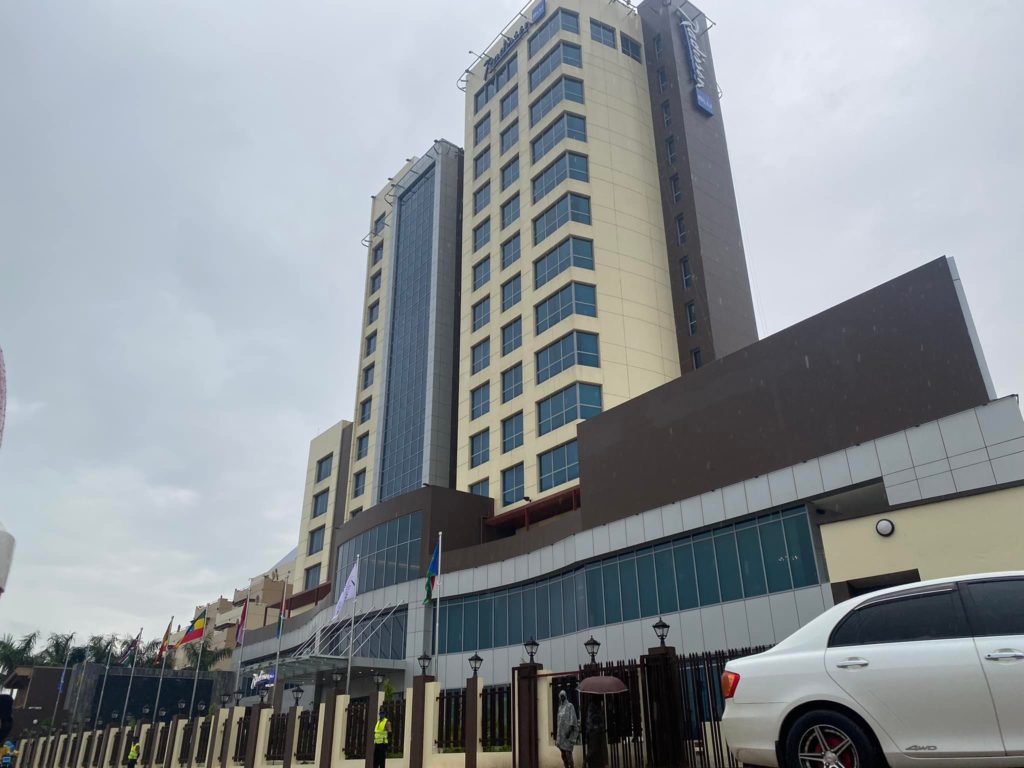
Debut day: External view of Radisson Blu Juba Hotel/ Guards brave the rain to keep gate crashers at bay

In 2006, Juba’s communities didn’t have toilets and eased off in open fields. The hotel row, now occupied by several classy brands, of which Radisson Blu is the latest, was a bushy wasteland bordering roughly a square kilometer cemetery that was many people’s open toilet. In the rainy season, water flowed in channel under a road bridge, ferrying all this waste down into the Nile.

“We used to think that no construction could ever happen here because of the stream and the cemetery at the corner,” the second lady adds.  

“Money can do anything truly,” she adds. “If you are at the top of the hotel, you can have a clear picture of the city, the Nile River, and of course the ghosts in the cemetery that might haunt you.”

They smile.

DO YOU KNOW ME?

About eight minutes go by. The ladies walk back to the car, inquiring why there is delay in processing their entry. The guard tells them that they are not on the guest list.

“Do you really know him (director)?” asks one of the women.

Meanwhile, the director makes frantic phone calls, presumably related to the bounce.

“Ita bi aruf eni?” (Do you know me?”), a cliché often used by people to abuse power and skirt the rules by scaring the other party, is thrown around in abundance during the Radisson Blu Blue Hotel grand opening today and it is only May 24.

The guard ignores them.

The ladies get back into the car, which drives to park opposite the Hotel, joining dozens of disappointed gatecrashers and passersby in admiring the area’s changing landscape.

The change has been swift: From an iron sheets walled slum that produced an eternity of stench from the open toilet to aerial scrappers of luxurious hotels and corporate headquarters.

And it is that change that officials allude to as the hotel opens.

“The inauguration of Radisson Blu Blu Hotel in Juba today is a clear sign that Juba’s landscape is changing for the better” President Kiir said at the officials opening. “It’s also a sign of the progress we have made as a government.”

Yet, the change is not simply in terms of landscape.

The quality of service at Juba’s hotels is changing as more competition enters the market, pushing service providers to dial up their customer care skills or bust.

And now, from the remarks from Radisson Blu, it is clear that the hotel is introducing another facet to the competition- how secure is your hotel?

At the debut, even diplomats and government officials queue to confirm their invitations. The media, too, is missing.

“How dare do you keep us out while it’s raining? We are here for your own good”, a pressman yells, before running to a nearby tea spot to protect his camera from the rain. Officials would later tell TIME that the journalists who didn’t was to do with protocol: many arrived after the President was seated, he said.

“In true Radisson Blu style, my passionate team and I look forward to welcoming and making every moment matter for our guests and the community of Juba in a hotel where safety & security are a top priority,” says George Balassis, General Manager, Radisson Blu Hotel, Juba.

In fact, where other hotels hire security firms, Radisson Blu Blue has trained its own.

Deepu Raj, the Radisson Blu Juba’s director of Sales and Marketing, told the Time that 80% of their staff are local. “For the past six months, we have been training South Sudanese in all sectors of the hotel’s operation – from security to service and catering because we don’t outsource our services. Outsourcing things like security can compromise our values and vision” Raj says.

In a break from most hotels in Juba, the hotel does not offer nightclub services. According to Raj, their prices are competitive but slightly above the rest because they import most products. 

In fact, Gabriel Mabior of Hotel and Catering Association says the hotel has lived up to its billing. Mabior tells TIME that they will make sure that quality of service is achieved in line with the development of the capacity of the locals.

“As an association, we have a system of distributing South Sudanese with hotel operation potential to be trained and mentored by the hotels and we are happy Radisson Blu is doing just that,” Mabior said.

The Radisson Blu Hotel Group is one of the world’s largest hotel groups with nine distinctive hotel brands and more than 1,700 hotels in operation and under development in 120 countries.

Some say that the up-upscale hotel – part of Radisson Blu Hotel Group, which includes Radisson Blu Collection, Radisson Blu, Radisson Blu RED, Radisson Blu Individuals, Park Plaza, Park Inn by Radisson Blu, Country Inn & Suites by Radisson Blu, and prizeotel – will attract more investors, especially in the hospitality sector, and force clients to find their levels.

“Juba will soon be littered with five Star hotels instead of human waste in empty lands,” says Deng DENG MAJOK, A local pub owner in Nyakuron says. “Many competitors will look at Radisson Blu and join the party.”

- A word from our sponsors -

sponsored: GRE. GMAT. TOEFL. IELT CLASSESspot_img

Most Popular

More from section

More Courage Than Before: Female Monitors Strengthening Early Warning Systems in South Sudan

Simona Ali, an Early Warning Monitoring Fellow from Wau, says the fellowship created a space for female journalists to share experiences and learn from each other. By passing this knowledge on to colleagues in her newsroom, she is helping strengthen awareness of journalist safety and professional rights

Speaking Up for Rights: Female Monitors Strengthening Early Warning Systems in South Sudan

Catherine Adut, an Early Warning Monitoring Fellow from Lakes State, says the fellowship helped her understand her rights and speak up against unfair treatment. Today, she encourages other female journalists to report harassment, defend their rights, and support one another in the newsroom.

Confidence to Stand Up: Female Monitors Strengthening Early Warning Systems in South Sudan

Viola Nyoka, an Early Warning Monitoring Fellow from Yei, says the fellowship helped her understand the risks female journalists face and the importance of speaking up. Through shared experiences with colleagues across South Sudan, she gained the confidence to challenge exploitation, report harassment, and stand up for her rights in the newsroom.

Knowing Where to Turn: Female Monitors Strengthening Early Warning Systems in South Sudan

Vivian Nandege, an Early Warning Monitoring Fellow from Yei, says the fellowship helped her understand where to seek support when facing challenges in journalism. Through connections with other female journalists, she has gained confidence, shared knowledge, and built a stronger professional network.

- A word from our sponsors -

spot_img

Read Now

More Courage Than Before: Female Monitors Strengthening Early Warning Systems in South Sudan

Simona Ali, an Early Warning Monitoring Fellow from Wau, says the fellowship created a space for female journalists to share experiences and learn from each other. By passing this knowledge on to colleagues in her newsroom, she is helping strengthen awareness of journalist safety and professional rights

Speaking Up for Rights: Female Monitors Strengthening Early Warning Systems in South Sudan

Catherine Adut, an Early Warning Monitoring Fellow from Lakes State, says the fellowship helped her understand her rights and speak up against unfair treatment. Today, she encourages other female journalists to report harassment, defend their rights, and support one another in the newsroom.

Confidence to Stand Up: Female Monitors Strengthening Early Warning Systems in South Sudan

Viola Nyoka, an Early Warning Monitoring Fellow from Yei, says the fellowship helped her understand the risks female journalists face and the importance of speaking up. Through shared experiences with colleagues across South Sudan, she gained the confidence to challenge exploitation, report harassment, and stand up for her rights in the newsroom.

Knowing Where to Turn: Female Monitors Strengthening Early Warning Systems in South Sudan

Vivian Nandege, an Early Warning Monitoring Fellow from Yei, says the fellowship helped her understand where to seek support when facing challenges in journalism. Through connections with other female journalists, she has gained confidence, shared knowledge, and built a stronger professional network.

Strengthening Professional Networks: Female Monitors Strengthening Early Warning Systems in South Sudan

Cecilia John Akile, an Early Warning Monitoring Fellow from Wau, says the fellowship helped her build stronger professional connections with journalists across South Sudan. Through the network, she has learned the importance of speaking openly about challenges and collaborating with colleagues to find solutions

Standing Firm Under Pressure: Female Monitors Strengthening Early Warning Systems in South Sudan

Assunta Aluel, a journalist from Twic County, says the Monitoring Fellowship helped her remain calm and professional when she faced questioning after reporting a sensitive community story. The training equipped her with the confidence and knowledge to navigate pressure while continuing her work.

Building Stronger Connections: Female Monitors Strengthening Early Warning Systems in South Sudan

Aleng Vicky, an Early Warning Monitoring Fellow from Torit, says the fellowship helped female journalists across Eastern Equatoria connect and share experiences. Through new communication platforms and peer discussions, women journalists are building stronger networks and supporting each other in the profession.

From Connection to Courage: Female Monitors Strengthen Early Warning Systems in South Sudan

"At the back of your mind, when covering news, you must remember there are things you must follow while doing this. That has instilled more confidence in us than before." - ARICH DENG

Forging a Lifeline: Female Monitors Power Early Warning Systems in South Sudan

An early warning system fellowship empowers frontline monitoring fellows to detect risks early, trigger rapid response, and strengthen protection support for those facing threats.

The Mic Was Silenced: A Young Female Journalist Struggles to Reclaim the Airwaves in South Sudan

They shut it down after a song—just a traditional tune from the wrong community—played during a flare-up in local fighting. Officials stormed in, seized the keys, and warned the staff: One more mistake, and the whole station is gone for good. For a moment, Achol was jobless...

 “If You Don’t Have the Heart for It, You Can’t Carry On”

As a child, she fled bombings by the Sudanese government and attacks by the Ugandan rebel Lord’s Resistance Army, living a refugee live in DR-Congo, CAR, and Uganda. As a woman, she faced down militias. Today, she stands at the frontline of media freedom in Western Equatoria...