
Kiir changes his currency 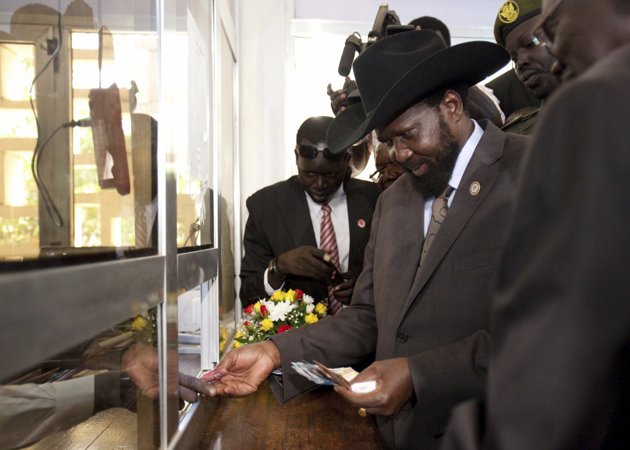
The Company that had been printing the currency was identified and was intimidated and threatened until it decided to abandon the work. Before the late Garang could return to the negotiation table, the bid for a new currency was already dead
MABIOR PHILIP MACH AND DANIEL DENG BOL
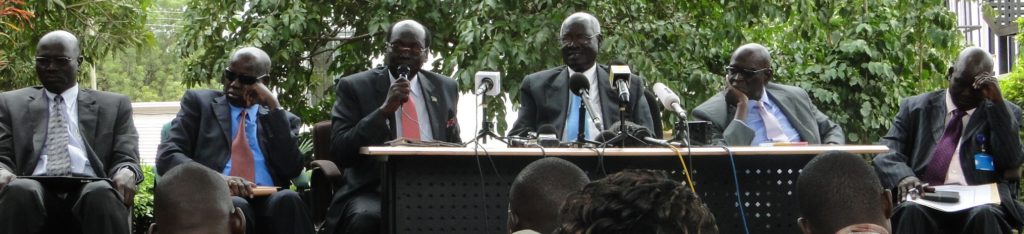
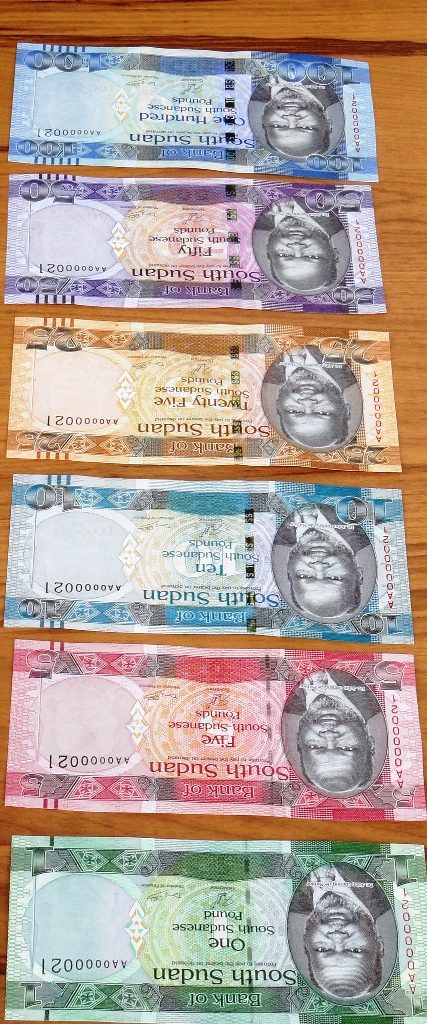
This, Central Bank Governor Elijah Malok said as he unveiled a new currency note with Dr. John Garang on its face, is a mark of respect for him and a mark for the respect of south Sudanese who had struggled since Sudan’s independence as a country more than a half century ago.
But John Garang, the man who graces the South Sudan currency, himself had plans for a new currency even before the peace was signed – but the effort and name of the printing company leaked, leading to a sabotage of the deal, which now seems to explain the secrecy with which the money was printed this time around.
While negotiating the 2005 peace deal in Nairobi, Dr. Garang called for a meeting of the top brass of the guerilla fighters, multiple sources say. Garang told them that peace was on the horizon and that it was necessary for the south to have its own currency. The currency was to be called the Sudanese pound and it would replace the Sudanese Dinars, which literally means “fire religion.”
A company was contracted to design the purported currency and when a sample was ready the late Garang called for a press conference to reveal the facts about the currency; his Secretary Dr. Samason Kwaje, who died last year in Aga Khan Hospital in Nairobi, circulated the product copies of the currency.
Missing note
However, when the currency notes were about to be collected back at the news conference, one of the notes went missing and was in turn used by the northern foes to trace the origins of the currency.
The company that had been printing the currency was identified and was intimidated and threatened until it decided to abandon the work.
Before the late Garang could return to the negotiation table, the bid for a new currency was already dead.
When the Comprehensive Peace Deal (CPA) was signed later in 2005, the two regions continued to use the Sudanese dinars only to have it replaced with the Sudanese pound in 2007.
Finance Minister David Deng Athorbei now says that that success with printing the new currency is due to the secrecy associated with the process.
“There were lots of criticism that, why was I preparing in secrecy,” Athorbei said. “Now the currency is out; it belongs to the Central Bank of South Sudan and really we thank and we congratulate ourselves for being ahead of time.”
The currency was printed in Britain by a company called De la Rue.
“My work, when I was preparing for the new currency, is now finished,” Athorbei said last week. “It was a difficult task and I had to carry it out with the support from the President.”
Elijah Malok underplays absence of date on new currency
Meanwhile, Central Bank Governor Elijah Malok has warned that the North Sudan Pound could be used to destroy the South Sudan economy, as he underplayed the absence of dates on the currency.
“Some of the countries have dates on their currencies while some do not,” Malok said. “For instance, the British Pound is not having a date on it; instead it has the head of the queen. Rand of South Africa did not have a date on it and Canadian Dollar did not have a date on it.”
The new Pound, launched by President Salva Kiir Monday replaces the Sudanese Pound, but the public has raised questions about the lack of a date on the currency. The US Dollar has a year of manufacture, and so do some regional currencies.
Even the Sudanese Pound has a date of manufacture. But Malok said this was not important since the currency is still legal tender.
“Your money is having a serial; It starts with letter ‘A, and by the time it reaches letter Z it’s possible the children of our children will be the ones to constitute it,” Malok said. “It takes time for money to be phased out from the market. Therefore, those of you who have been concerned about the money not having dates, you have no reason to worry, no reason to be afraid. Your money is sanctioned by the Government of the Republic of South Sudan as the official tender of the Republic.”
Malok said the Sudanese Pound should be changed faster, probably in a month and half, warning that its continued stay in the market could be used to fail the economy of the new country.
Bank of South Sudan officials have spent the past week in meetings, some lasting late into the night as they try to figure out how expedite the currency changeover process, since the South Sudan Pound first became legal tender on Monday, replacing the Sudan Pound.
“As long we do not change to its equivalent, and it is still the legal tender In the North, a lot of money will pour in and it will destroy our economy,” Malok said. “Therefore, the speed is a matter. And this month South Sudan Pound is equivalent to SDP and therefore one will not lose any value after change.”
“I would also want to appeal to our governors who are here by coincidence that they need to work with the technical committee so that the change of the currency takes off and becomes efficient. And when it comes to efficiency, we can actually save the time and within three months we can have this money withdrawn — the Sudanese Pound — within one month and half.
“There were lots of criticism that, why was I preparing in secrecy? Now the currency is out; it belongs to the Central Bank of South Sudan and, really we thank and we congratulate ourselves for being ahead of time. My work, when I was preparing for the new currency, is now finished. It was a difficult task and I had to carry it out with the support from the President”
He’s with me
The inclusion of Dr. John Garang’s portrait in South Sudan Pounds has been in the hearts of almost every citizen.
“When I saw him on my money, I feel he is with me. I feel he is the one leading the South,” said Thon Dut, a government employee. “He is the man who brought for us this freedom. When I look into the money, I recall the time he greeted me in Panywudu,” added Thon, a rebel soldier, now a traffic police officer.
To Tot Gatluak, Garang this is a symbol of unity.
His portrait in the new money will always renew the ability of the people of South Sudan to overcome their challenges and emerge one. “Garang forgave his enemies and united them again under him,” said Tot. “For him in the currency, we recall how he kept our moral as one in the fighting,” he added, referring to the decades-long bush war.
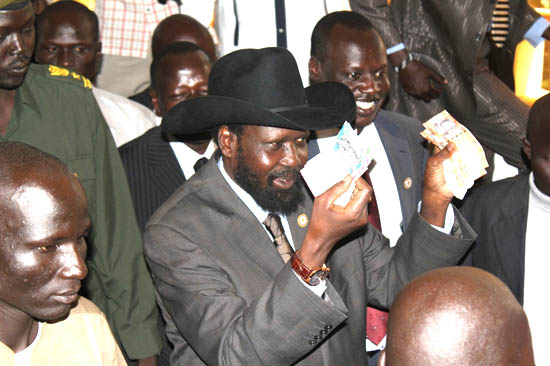
The new currency has been launched and it is being exchanged with the old one at a one-on-one rate. Centers are being established.
Kenya Central Bank offers to help
PROFESSOR DUGU, Governor Central Bank of Kenya
It is a great achievement because it re-organizes the economy and it organizes the payment system and re-organizes and strengthens the independence of this country . Kenya has been working very hard in collaboration with Elijah Malok just to recognize this state and this has paved the way for continued friendship for the two institutes that are enjoying and I am sure we are going to manage and try perhaps to overcome the challenges that are coming always.
I am also trying to look with reasonable consultation to identify the area of business opportunities in which technical assistance can be provided by the Bank of Kenya. We are going to recognize the enormous task by the BOSS.
The central Bank of Kenya has given its own commitment and supports the Bank of South Sudan in the transformation process and I am sure that commitment has been there over the years and I think it is the time to step it up so that challenges we foresee are not going to be challenges any more. But let me say that in finishing I do consider that in the wider net work of E. Africa, we will give a chance to this Bank of South Sudan to report some of the challenges that we have gone through in the past and we are working on several aspects of them.
In the first, which perhaps when we work through the BOSS to improve on our payment and the clearing system ,we are working on East Africa payment system and it is going to be very important in terms of facilitating trade. We are working very hard as governors of the E. African region on currency convertibility and that we are launching this currency today thinking of convertibility in the future.
My work is done
FINANCE MINISTER DENG ATHORBEI
My work, when I was preparing for the new currency, is now finished. It was a difficult task and I had to carry it out with the support from the President. There were lots of criticism that why was I preparing in secrecy now the currency is out it belongs to the Central Bank of South Sudan and really we thank and we congratulate ourselves for being ahead of time. Otherwise, we would have been in a bad situation if the process had started today. Many people advised that we start the process after having the nation. This would have taken us two years before having the currency. Thanks to the President publicly for the support and I call upon him to come forward to bless the currency as the first citizen of the country.
PRESIDENT SALVA KIIR
I want to sincerely advise those of you who have money outside the country you bring your money back to this bank- it will benefit you. I know many of you have very huge account outside the country , so you repatriate your money Back to this Central Bank