

HomeENTERPRISE & IMPACTENTERPRISE & IMPACTInvestors and lenders smell...

Investors and lenders smell a joker from far; Only success will guarantee you more money

Some things will go wrong, but it is Mary’s ability to deal with the blips successfully, her ability to make more and more money and to expand operations, that really interests potential investors. Investors smell hard work and success is your perfect business plan.”

MELODY ATIL

Designation

COLUMNIST

“I need a loan to start a restaurant on my land,” Mary, an eager young woman keen to get into business, says. “Can you help me with my business plan?”

Mary’s business is just off the centre of town next to some UN and international NGO’s offices.

“Well of course”, I reply smiling.

I take her draft plan from her. I scribble some corrections and further details.

“Here you go”, I say as I hand her the information detailed below:
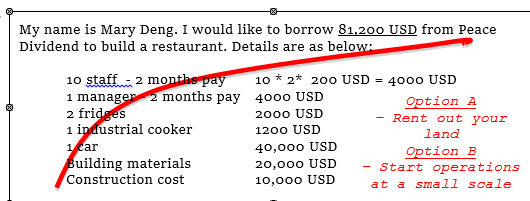
The majority of entrepreneurs like Mary in South Sudan, do not need a business plan and do not need a loan.

They think they do, but are practically un-fundable. No banks or friends will lend you money if you have not started yourself.

And if they do, they will take a lion’s share of your profits, which means you might as well not get into business at all.

This may be what you want – an easy way to make money without sweat and hard work. If that is what you wish, the best option is to rent out your land.  It won’t give you much money, but it is one way to make money in the short term if that is what you need.

In Mary’s case – the perfect business plan is to start operations herself.

Instead of looking round for people to invest in her restaurant with her, she should save up some cash over the next three months, buy a small cooker, a couple of plastic chairs and tables, and perhaps a tin roof balanced on a couple of timbers and start!

If she is working in an organization, she should hire the best cook she knows amongst her friends and family.

This will ensure she is making money from day one…. the crux of running a successful business.

Some things will go wrong, but it is Mary’s ability to deal with the blips successfully, her ability to make more and more money and to expand operations, that really interests potential investors. Investors smell hard work and success is your perfect business plan.

There are just a couple of things you need to know to start:

1 – Profit – if you add up the revenue (cash in hand) you expect to make and deduct all your costs > this tells you how much money you are making each month i.e. your profit.

E.g. 50 meals @ 5 SDG for 30 days = 50 * 5 * 30 = 7,500 (revenue)

Vegetables and Coal = 2,000 (variable costs as these vary with revenue)

Cook’s salary = 3,000 (fixed costs as these are the same irrespective of revenue)

Profit = 7,500 – 2000 – 3000 = 2,500 SDG

2 – Breakeven – how much time you take to recover your initial fixed costs of investment

E.g.  Cooker – 4000 SDG

Plastic chairs and tables – 1500 SDG

Tin roof balanced on a couple of timbers – 2000 SDG

Breakeven = 7,500 / 2,500 = 3 months

3 – Start Small – do not buy anything you do not absolutely need to start making money.  The first priority is to get an income stream, not to spend all your cash. Do not jump in and leave your job (if you have one). Start while you work – that is a much less risky strategy. Most times you will find you have forgotten to add in a crucial cost, or something goes wrong. This quite often applies to business, but the better you do your research and homework, the faster you learn of other successful businessmen, the less you will have to struggle before reaching success.

4 – Research, Compare, Adapt – perhaps the profit could be a lot larger if you were engaged in another activity, or sector? Ask around, do your homework. If you do not breakeven in less than a year… I challenge this is the right activity you should engage in. Look around you at what the foreigners are doing? Are they engaging in your said activity? If not, why not? They are usually quite aggressive in finding business opportunities.  Could you be making more money if you were operating at a larger scale? If so, would it no make more sense to partner with three of four buddies and benefit from these economies of scale by rolling out a larger project? Good luck with you endeavours.

****Melody Atil, founder of Peace Dividend, is a financial and private sector specialist, and previously managed components of the World Bank’s private sector development project for Southern Sudan. She’s a graduate of Oxford.

- A word from our sponsors -

sponsored: GRE. GMAT. TOEFL. IELT CLASSESspot_img

Most Popular

More from section

More Courage Than Before: Female Monitors Strengthening Early Warning Systems in South Sudan

Simona Ali, an Early Warning Monitoring Fellow from Wau, says the fellowship created a space for female journalists to share experiences and learn from each other. By passing this knowledge on to colleagues in her newsroom, she is helping strengthen awareness of journalist safety and professional rights

Speaking Up for Rights: Female Monitors Strengthening Early Warning Systems in South Sudan

Catherine Adut, an Early Warning Monitoring Fellow from Lakes State, says the fellowship helped her understand her rights and speak up against unfair treatment. Today, she encourages other female journalists to report harassment, defend their rights, and support one another in the newsroom.

Confidence to Stand Up: Female Monitors Strengthening Early Warning Systems in South Sudan

Viola Nyoka, an Early Warning Monitoring Fellow from Yei, says the fellowship helped her understand the risks female journalists face and the importance of speaking up. Through shared experiences with colleagues across South Sudan, she gained the confidence to challenge exploitation, report harassment, and stand up for her rights in the newsroom.

Knowing Where to Turn: Female Monitors Strengthening Early Warning Systems in South Sudan

Vivian Nandege, an Early Warning Monitoring Fellow from Yei, says the fellowship helped her understand where to seek support when facing challenges in journalism. Through connections with other female journalists, she has gained confidence, shared knowledge, and built a stronger professional network.

- A word from our sponsors -

spot_img

Read Now

More Courage Than Before: Female Monitors Strengthening Early Warning Systems in South Sudan

Simona Ali, an Early Warning Monitoring Fellow from Wau, says the fellowship created a space for female journalists to share experiences and learn from each other. By passing this knowledge on to colleagues in her newsroom, she is helping strengthen awareness of journalist safety and professional rights

Speaking Up for Rights: Female Monitors Strengthening Early Warning Systems in South Sudan

Catherine Adut, an Early Warning Monitoring Fellow from Lakes State, says the fellowship helped her understand her rights and speak up against unfair treatment. Today, she encourages other female journalists to report harassment, defend their rights, and support one another in the newsroom.

Confidence to Stand Up: Female Monitors Strengthening Early Warning Systems in South Sudan

Viola Nyoka, an Early Warning Monitoring Fellow from Yei, says the fellowship helped her understand the risks female journalists face and the importance of speaking up. Through shared experiences with colleagues across South Sudan, she gained the confidence to challenge exploitation, report harassment, and stand up for her rights in the newsroom.

Knowing Where to Turn: Female Monitors Strengthening Early Warning Systems in South Sudan

Vivian Nandege, an Early Warning Monitoring Fellow from Yei, says the fellowship helped her understand where to seek support when facing challenges in journalism. Through connections with other female journalists, she has gained confidence, shared knowledge, and built a stronger professional network.

Strengthening Professional Networks: Female Monitors Strengthening Early Warning Systems in South Sudan

Cecilia John Akile, an Early Warning Monitoring Fellow from Wau, says the fellowship helped her build stronger professional connections with journalists across South Sudan. Through the network, she has learned the importance of speaking openly about challenges and collaborating with colleagues to find solutions

Standing Firm Under Pressure: Female Monitors Strengthening Early Warning Systems in South Sudan

Assunta Aluel, a journalist from Twic County, says the Monitoring Fellowship helped her remain calm and professional when she faced questioning after reporting a sensitive community story. The training equipped her with the confidence and knowledge to navigate pressure while continuing her work.

Building Stronger Connections: Female Monitors Strengthening Early Warning Systems in South Sudan

Aleng Vicky, an Early Warning Monitoring Fellow from Torit, says the fellowship helped female journalists across Eastern Equatoria connect and share experiences. Through new communication platforms and peer discussions, women journalists are building stronger networks and supporting each other in the profession.

From Connection to Courage: Female Monitors Strengthen Early Warning Systems in South Sudan

"At the back of your mind, when covering news, you must remember there are things you must follow while doing this. That has instilled more confidence in us than before." - ARICH DENG

Forging a Lifeline: Female Monitors Power Early Warning Systems in South Sudan

An early warning system fellowship empowers frontline monitoring fellows to detect risks early, trigger rapid response, and strengthen protection support for those facing threats.

The Mic Was Silenced: A Young Female Journalist Struggles to Reclaim the Airwaves in South Sudan

They shut it down after a song—just a traditional tune from the wrong community—played during a flare-up in local fighting. Officials stormed in, seized the keys, and warned the staff: One more mistake, and the whole station is gone for good. For a moment, Achol was jobless...

 “If You Don’t Have the Heart for It, You Can’t Carry On”

As a child, she fled bombings by the Sudanese government and attacks by the Ugandan rebel Lord’s Resistance Army, living a refugee live in DR-Congo, CAR, and Uganda. As a woman, she faced down militias. Today, she stands at the frontline of media freedom in Western Equatoria...