

HomeLIVING IN SOUTH SUDANAs WFP Food Runs...

As WFP Food Runs Out, World Bank Pushes for Use of Oil Money to Develop Agriculture

On any given day, food trucks carefully ride along South Sudan’s highway that has over the past decade given way to gapping potholes that become lakes when heavy rains come.

With a major food crisis looming in much of the country following the announcement by the World Food Programme that it won’t distribute anymore food this year, the value of such trucks is likely to rise, but the deteriorating road that has seen trucks overturn and the mushrooming security checks that have often become extortion points will make such food imports expensive.

In the midst of such a doomsday scenario, the World Bank has a different take: use oil proceeds to develop the country’s agricultural sector so that the country reduces reliance on imported food imports.
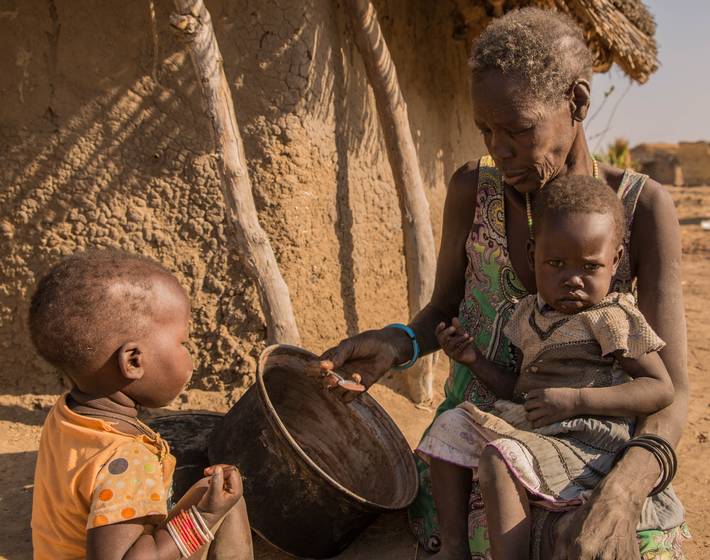
A hungry mother feeding her two malnourished kids

“Some of the conversations we have been having with authorities and policy makers within the World Bank is how do we ensure South Sudan transitions from humanitarian mode to more development mode in terms of production,” the World Bank Country Economist for South Sudan Joseph Mawejje told policy makers Wednesday.

“Oil money can be used to do more to support agricultural inputs, such as seeds, extension services, and the right human capital (skills). There is an opportunity to move into that direction with the current peace in the country.”

Mr. Mawejje made the remarks during the launch of the latest World Bank economic analysis for South Sudan titled Directions for Reform: A country Economic memorandum for Recovery and Resilience, which highlights the need for the country to leverage its natural capital in the agriculture and oil sectors to support recovery and resilience.  

In summarizing the analysis, Mr. Mawejje said three messages emerge from this report.

I

“First, there is a peace dividend in South Sudan. South Sudan’s real GDP per capita in 2018 was estimated at one third of the counterfactual estimated for a non-conflict scenario,” he said. “Thus, maintaining peace can by itself be a strong driver of growth. Second, with better governance and accountability, South Sudan’s oil resources can drive transformation. Third, South Sudan’s chronic food insecurity could be reversed with targeted investments to improve the resilience of the agricultural sector.”

NOT ENOUGH TO EAT

The remarks followed a June 14 announced by the World Food Programme (WFP) that funding shortages mean that it is unable to dole out any more food this year, heightening the risk of starvation for 1.7 million people. More than half the population (60 percent) is already grappling with severe food insecurity during the lean season, fuelled by continuing conflict, severe flooding, localized drought, and soaring food prices exacerbated by the crisis in Ukraine, according to the WFP.

“We are extremely concerned about the impact of the funding cuts on children, women and men who will not have enough to eat during the lean season,” Adeyinka Badejo, Acting Country Director of the World Food Programme in South Sudan, said in a statement.

“These families have completely exhausted their coping strategies. They need immediate humanitarian assistance to put food on the table in the short-term and to rebuild their livelihoods and resilience to cope with future shocks.”

SUPPORT AGRICULTURE

The WFP move is a major blow for much of the displaced population caught up in recurring cycles of violence.

The cost of the conflict has been immense. Real Gross Domestic Product per capita in 2018 was estimated at one-third of the counterfactual estimated for a non-conflict scenario.  Reforms have been undertaken in public financial management, but strengthened governance systems are required to broaden the gains, according to the World Bank.

“Getting South Sudan to realize its potential will require steps aimed at consolidating peace and strengthening institutions, as well as targeted reforms tailored at harnessing South Sudan’s rich natural capital for development impact as first-order prerequisites for inclusive economic recovery,” said Firas Raad, World Bank Country Manager for South Sudan.

Oil and agriculture are the most important sectors of South Sudan’s economy, with oil contributing to 90 percent of revenue and almost all exports, while agriculture remains the primary source of livelihood for more than four in five households (80%).

The World Bank analysis outlines several recommendations, including:

Support the resilience of agricultural sector to reverse the food crisis and achieve food security for all households.

Addressing the drivers of fragility, ending all forms of conflict, and ensuring peace and stability in all parts of the country are prerequisites for an inclusive economic recovery.

Improve oil sector governance by ensuring that all oil revenues and expenditures are on budget and used effectively to achieve national development goals

Stay the course on macroeconomic reforms and continue on a stabilization path, building on key milestones already achieved in unifying the exchange rate and taming inflation.

- A word from our sponsors -

sponsored: GRE. GMAT. TOEFL. IELT CLASSESspot_img

Most Popular

More from section

More Courage Than Before: Female Monitors Strengthening Early Warning Systems in South Sudan

Simona Ali, an Early Warning Monitoring Fellow from Wau, says the fellowship created a space for female journalists to share experiences and learn from each other. By passing this knowledge on to colleagues in her newsroom, she is helping strengthen awareness of journalist safety and professional rights

Speaking Up for Rights: Female Monitors Strengthening Early Warning Systems in South Sudan

Catherine Adut, an Early Warning Monitoring Fellow from Lakes State, says the fellowship helped her understand her rights and speak up against unfair treatment. Today, she encourages other female journalists to report harassment, defend their rights, and support one another in the newsroom.

Confidence to Stand Up: Female Monitors Strengthening Early Warning Systems in South Sudan

Viola Nyoka, an Early Warning Monitoring Fellow from Yei, says the fellowship helped her understand the risks female journalists face and the importance of speaking up. Through shared experiences with colleagues across South Sudan, she gained the confidence to challenge exploitation, report harassment, and stand up for her rights in the newsroom.

Knowing Where to Turn: Female Monitors Strengthening Early Warning Systems in South Sudan

Vivian Nandege, an Early Warning Monitoring Fellow from Yei, says the fellowship helped her understand where to seek support when facing challenges in journalism. Through connections with other female journalists, she has gained confidence, shared knowledge, and built a stronger professional network.

- A word from our sponsors -

spot_img

Read Now

More Courage Than Before: Female Monitors Strengthening Early Warning Systems in South Sudan

Simona Ali, an Early Warning Monitoring Fellow from Wau, says the fellowship created a space for female journalists to share experiences and learn from each other. By passing this knowledge on to colleagues in her newsroom, she is helping strengthen awareness of journalist safety and professional rights

Speaking Up for Rights: Female Monitors Strengthening Early Warning Systems in South Sudan

Catherine Adut, an Early Warning Monitoring Fellow from Lakes State, says the fellowship helped her understand her rights and speak up against unfair treatment. Today, she encourages other female journalists to report harassment, defend their rights, and support one another in the newsroom.

Confidence to Stand Up: Female Monitors Strengthening Early Warning Systems in South Sudan

Viola Nyoka, an Early Warning Monitoring Fellow from Yei, says the fellowship helped her understand the risks female journalists face and the importance of speaking up. Through shared experiences with colleagues across South Sudan, she gained the confidence to challenge exploitation, report harassment, and stand up for her rights in the newsroom.

Knowing Where to Turn: Female Monitors Strengthening Early Warning Systems in South Sudan

Vivian Nandege, an Early Warning Monitoring Fellow from Yei, says the fellowship helped her understand where to seek support when facing challenges in journalism. Through connections with other female journalists, she has gained confidence, shared knowledge, and built a stronger professional network.

Strengthening Professional Networks: Female Monitors Strengthening Early Warning Systems in South Sudan

Cecilia John Akile, an Early Warning Monitoring Fellow from Wau, says the fellowship helped her build stronger professional connections with journalists across South Sudan. Through the network, she has learned the importance of speaking openly about challenges and collaborating with colleagues to find solutions

Standing Firm Under Pressure: Female Monitors Strengthening Early Warning Systems in South Sudan

Assunta Aluel, a journalist from Twic County, says the Monitoring Fellowship helped her remain calm and professional when she faced questioning after reporting a sensitive community story. The training equipped her with the confidence and knowledge to navigate pressure while continuing her work.

Building Stronger Connections: Female Monitors Strengthening Early Warning Systems in South Sudan

Aleng Vicky, an Early Warning Monitoring Fellow from Torit, says the fellowship helped female journalists across Eastern Equatoria connect and share experiences. Through new communication platforms and peer discussions, women journalists are building stronger networks and supporting each other in the profession.

From Connection to Courage: Female Monitors Strengthen Early Warning Systems in South Sudan

"At the back of your mind, when covering news, you must remember there are things you must follow while doing this. That has instilled more confidence in us than before." - ARICH DENG

Forging a Lifeline: Female Monitors Power Early Warning Systems in South Sudan

An early warning system fellowship empowers frontline monitoring fellows to detect risks early, trigger rapid response, and strengthen protection support for those facing threats.

The Mic Was Silenced: A Young Female Journalist Struggles to Reclaim the Airwaves in South Sudan

They shut it down after a song—just a traditional tune from the wrong community—played during a flare-up in local fighting. Officials stormed in, seized the keys, and warned the staff: One more mistake, and the whole station is gone for good. For a moment, Achol was jobless...

 “If You Don’t Have the Heart for It, You Can’t Carry On”

As a child, she fled bombings by the Sudanese government and attacks by the Ugandan rebel Lord’s Resistance Army, living a refugee live in DR-Congo, CAR, and Uganda. As a woman, she faced down militias. Today, she stands at the frontline of media freedom in Western Equatoria...