

HomeLIVING IN SOUTH SUDANEthiopian Ambassador Voices concern...

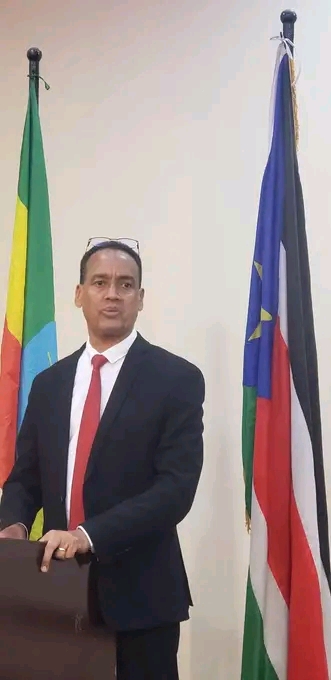
Ethiopian Ambassador Voices concern over South Sudan’s UnPaid Hotel, Construction Debts

BY AMBASSADOR NEBIL MAHAD

I am very pleased to welcome you all to this Ethio-South Sudanese Business Discussion Forum. I would also like to express my utmost pleasure in opening this forum with the aim of encouraging Ethiopians to be engaged in the existing business and investment opportunities in the Republic of South Sudan, which have immense benefits to the Business Community as well as to both Sisterly Countries. Our two sisterly countries’ bond has a concretized historical foundation, for we have the shared socio-cultural origin and aspirations. This is manifested by the Ethiopian wider public and consecutive leaders’ consistent and unreserved support to South Sudanese’s causes of equality and justice. This, in turn, has also interwoven us by blood and bones.

Emperor Selassie’s Role

To make it specific, active engagements of Emperor Haile Selassie in 1972 peace agreement process of ‘Anya-Nya’s’ movement, Mengistu Hailemariam’s backing to his SPLM/A comrades as well as the successive Ethiopian leaders’ close support in resolving South Sudanese conflict that occurred afterward the independence. Following the support emanated from the genuine motives of Ethiopia and other real partners, the destructive conflict ended in South Sudan, and we are of the conviction that lasting peace and path to prosperity is at hand to South Sudanese. Though the Ethiopian and South Sudanese People-to-people relations date back to the 1960’s, both countries have a lot to accomplish in forming economic ties, which is an important factor in fostering common peace and security, as well as in guiding political relations towards effective diplomatic cooperation. Obviously, the orientation of the recent world, prioritizes the economic cooperation, for it has a role towards the effectiveness of other areas of collaborations. Accordingly, both countries needed to give emphasis to economic ties for the mutual benefit of the two sides.

War Upends Agricultural Imports

To this end, we ought to boost the prevailing engagements by the business community between the two countries, which would be one of the contributions to the major economic cooperation we aspire after. As you are aware, since before the independence, Ethiopian community members have been living together with their fellow South Sudanese. Following the independence, some of them majorly involved in the hotel, housing, and in the construction sectors. There were also some other Ethiopians who had been importing agricultural products from Ethiopia to South Sudan through the border entry points. Nonetheless, this has stumbled over due to conflict in South Sudan that happened 8 years back. On the other hand, noticeable number of Ethiopians’ owned companies are still operating in South Sudan in the aforementioned sectors. Hence, we are of the view that, these companies have significant benefits expressly in job opportunities creations, experiences sharing, and technological skill transfers to South Sudanese as well as being means of tax income generation base for the government of South Sudan. The companies are also believed to be serving as one form in the people-to-people relations of the two sisterly countries through economic ties.  

Dear Ethiopian Business Community Members, Cognizant of enormous prospects in South Sudan, I would like to encourage Ethiopians to get involved more in the existing business and investment opportunities in the fields such as: agriculture and agro-processing, manufacturing, construction. I encourage you to consider educational, health, and the service sectors. These boost your benefit and have a role in South Sudan’s economic development, thereby fostering the economic ties between the two sisterly countries.

Rising discontent over Payments Delays

It would be proper to share here the kind of discontents, over the delay of payments, being heard from some companies owned by Ethiopians, which have been providing hotel accommodation services and operating different construction projects, as per agreements reached with authorities of South Sudan. In order to create conducive environment for the investments and businesses as well as to enable the companies to operate in full capacity and to salvage them from insolvency, I hope their cases will be solved in reasonable time. I am confident that in these ways a more conducive business environment would be fashioned, particularly, by giving satisfactory responses to the possible discontents like, solving the for so long delayed outstanding payment issues with the respective companies.

Still, Staying to Contribute South Sudan’s Development

Dear Ethiopian Business Community Members, with due respect and appreciation to your contributions in businesses and investments, I urge you all to strengthen your activities in full observance of the rules and regulations of the land and I encourage you to contribute to the development of South Sudan along with benefiting yourselves. Also, I extend my suggestion to the Ministries of Trade and Industry, Investment, Justice and Constitutional Affairs, and to South Sudan National Chamber of Commerce, Industry and Agriculture for providing continuous awareness to the business community on the legal affairs. In so doing, it’s quite likely to avoid any bottlenecks that might face both sides. In this case, I call on Ethiopians to engage in more businesses and investments using the existing opportunities in South Sudan. In this regard, I would like to reiterate the Embassy’s readiness in rendering the proper supports. I thank you.

This is an abridged version of the address of the Ethiopian Ambassador to a meeting of the Ethiopian business community with South Sudanese officials, including the Mayor and the South Sudanese Chamber of Commerce.

- A word from our sponsors -

sponsored: GRE. GMAT. TOEFL. IELT CLASSESspot_img

Most Popular

More from section

More Courage Than Before: Female Monitors Strengthening Early Warning Systems in South Sudan

Simona Ali, an Early Warning Monitoring Fellow from Wau, says the fellowship created a space for female journalists to share experiences and learn from each other. By passing this knowledge on to colleagues in her newsroom, she is helping strengthen awareness of journalist safety and professional rights

Speaking Up for Rights: Female Monitors Strengthening Early Warning Systems in South Sudan

Catherine Adut, an Early Warning Monitoring Fellow from Lakes State, says the fellowship helped her understand her rights and speak up against unfair treatment. Today, she encourages other female journalists to report harassment, defend their rights, and support one another in the newsroom.

Confidence to Stand Up: Female Monitors Strengthening Early Warning Systems in South Sudan

Viola Nyoka, an Early Warning Monitoring Fellow from Yei, says the fellowship helped her understand the risks female journalists face and the importance of speaking up. Through shared experiences with colleagues across South Sudan, she gained the confidence to challenge exploitation, report harassment, and stand up for her rights in the newsroom.

Knowing Where to Turn: Female Monitors Strengthening Early Warning Systems in South Sudan

Vivian Nandege, an Early Warning Monitoring Fellow from Yei, says the fellowship helped her understand where to seek support when facing challenges in journalism. Through connections with other female journalists, she has gained confidence, shared knowledge, and built a stronger professional network.

- A word from our sponsors -

spot_img

Read Now

More Courage Than Before: Female Monitors Strengthening Early Warning Systems in South Sudan

Simona Ali, an Early Warning Monitoring Fellow from Wau, says the fellowship created a space for female journalists to share experiences and learn from each other. By passing this knowledge on to colleagues in her newsroom, she is helping strengthen awareness of journalist safety and professional rights

Speaking Up for Rights: Female Monitors Strengthening Early Warning Systems in South Sudan

Catherine Adut, an Early Warning Monitoring Fellow from Lakes State, says the fellowship helped her understand her rights and speak up against unfair treatment. Today, she encourages other female journalists to report harassment, defend their rights, and support one another in the newsroom.

Confidence to Stand Up: Female Monitors Strengthening Early Warning Systems in South Sudan

Viola Nyoka, an Early Warning Monitoring Fellow from Yei, says the fellowship helped her understand the risks female journalists face and the importance of speaking up. Through shared experiences with colleagues across South Sudan, she gained the confidence to challenge exploitation, report harassment, and stand up for her rights in the newsroom.

Knowing Where to Turn: Female Monitors Strengthening Early Warning Systems in South Sudan

Vivian Nandege, an Early Warning Monitoring Fellow from Yei, says the fellowship helped her understand where to seek support when facing challenges in journalism. Through connections with other female journalists, she has gained confidence, shared knowledge, and built a stronger professional network.

Strengthening Professional Networks: Female Monitors Strengthening Early Warning Systems in South Sudan

Cecilia John Akile, an Early Warning Monitoring Fellow from Wau, says the fellowship helped her build stronger professional connections with journalists across South Sudan. Through the network, she has learned the importance of speaking openly about challenges and collaborating with colleagues to find solutions

Standing Firm Under Pressure: Female Monitors Strengthening Early Warning Systems in South Sudan

Assunta Aluel, a journalist from Twic County, says the Monitoring Fellowship helped her remain calm and professional when she faced questioning after reporting a sensitive community story. The training equipped her with the confidence and knowledge to navigate pressure while continuing her work.

Building Stronger Connections: Female Monitors Strengthening Early Warning Systems in South Sudan

Aleng Vicky, an Early Warning Monitoring Fellow from Torit, says the fellowship helped female journalists across Eastern Equatoria connect and share experiences. Through new communication platforms and peer discussions, women journalists are building stronger networks and supporting each other in the profession.

From Connection to Courage: Female Monitors Strengthen Early Warning Systems in South Sudan

"At the back of your mind, when covering news, you must remember there are things you must follow while doing this. That has instilled more confidence in us than before." - ARICH DENG

Forging a Lifeline: Female Monitors Power Early Warning Systems in South Sudan

An early warning system fellowship empowers frontline monitoring fellows to detect risks early, trigger rapid response, and strengthen protection support for those facing threats.

The Mic Was Silenced: A Young Female Journalist Struggles to Reclaim the Airwaves in South Sudan

They shut it down after a song—just a traditional tune from the wrong community—played during a flare-up in local fighting. Officials stormed in, seized the keys, and warned the staff: One more mistake, and the whole station is gone for good. For a moment, Achol was jobless...

 “If You Don’t Have the Heart for It, You Can’t Carry On”

As a child, she fled bombings by the Sudanese government and attacks by the Ugandan rebel Lord’s Resistance Army, living a refugee live in DR-Congo, CAR, and Uganda. As a woman, she faced down militias. Today, she stands at the frontline of media freedom in Western Equatoria...