
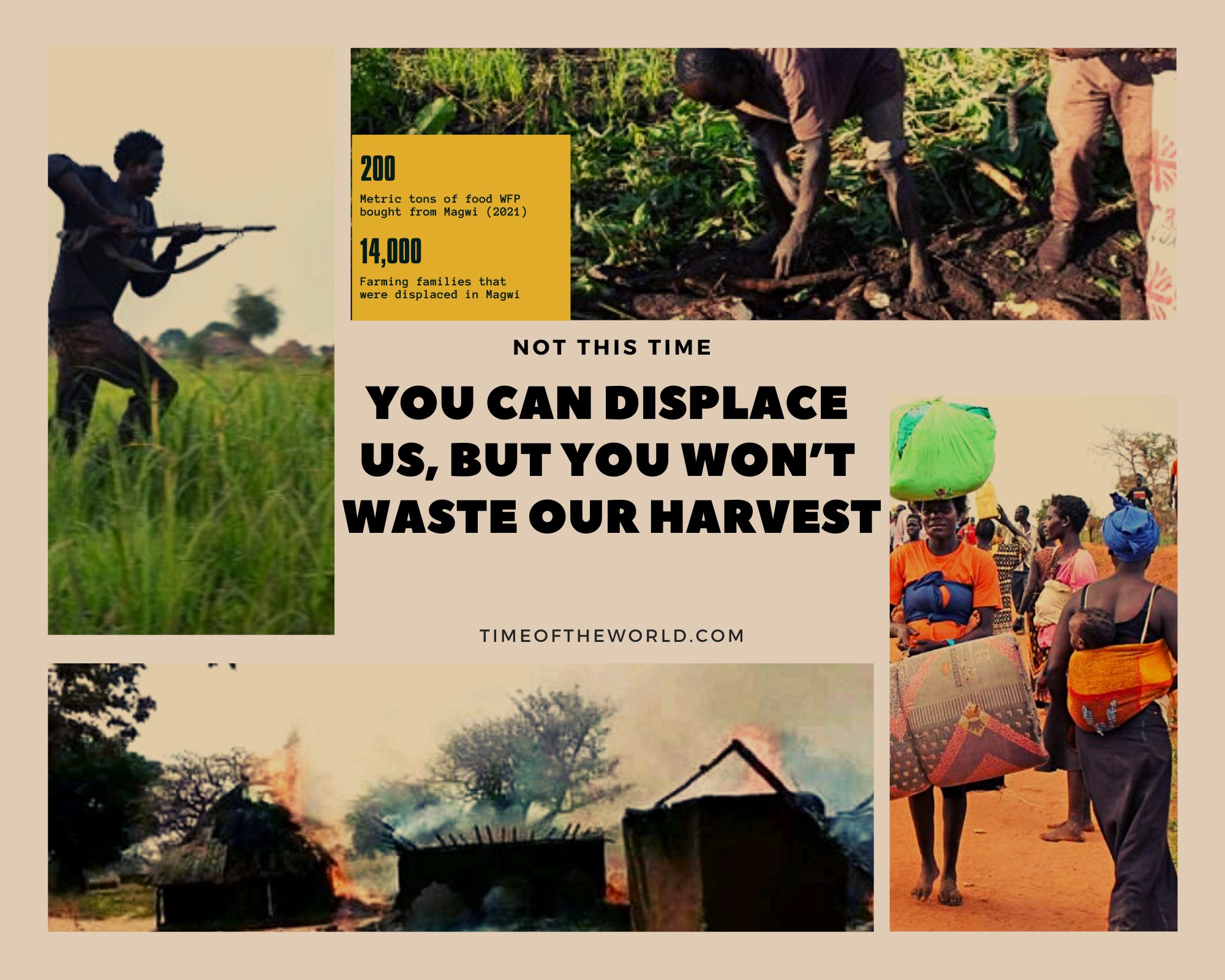
Magwi county was fast becoming the country’s food basket, its farmers supplying more than 200 metric tonnes of humanitarian food to World Food Programme (2021) before communal violence broke out in a region that was already filled with rebel fighters, displacing thousands of farming families. A band of harvest groups are saying , ‘Not this time’. They may be displaced again, but they won’t let their harvest rot in the fields
Augustine Andruga walks attentively, his face soaked in sweat from carrying a half-filled sack of cassava on his head and a panga on his left elbow.
In torn gray shorts with multi-colored patches darkened by farm dirt, reaches a tamarind tree by the footpath next to his home to welcoming friends.
“We have been waiting for you all morning; where did you go?” Onen John, a bowl of kwete (local brew) in his hands, asks.
Andruga quietly places his panga and sack of cassava down, using the later as a chair. “I went to pack my remaining simsim – the one I cut yesterday – because tomorrow I will have no time since I have to take the dry cassava to Upari Market.”
Opio Daniel quietly passes an empty bowl to Andruga, pointing to a 5-litre jerrycan of brew that they refer to as double-satisfaction (drunk and satisfied) and joking. “There, fill your stomach before greedy Onen gallops everything.” After twenty minutes, each man heads to one’s to cook and pack the dry cassava that each would return with to Upari the following day, pledging to converge again in the evening to complete the drink. Atapi is about 8 miles from Upari Trading Centre, where the men trek with their harvests for sale.
As do the other men, Augustine Andruga lives alone, his family displaced by fighting between pastoralists and farmers this year. Invisible from the surrounding banana plantation to the south and cassava trees to the north, his homestead is the envy of every creature that has a rat’s mentality. He has three mud and wattle, grass-thatched houses filled with 100-kg sacks of dried maize and cassava. In the compound, piles of cut sorghum hang atop improvised shelves, attracting singing birds. His dog, Aci (meaning ‘fire’) is a stagnant presence at the entrance of the main house, a reminder of where the gold in the homestead is stored. Andruga’s home area is called Atapi, named after a stream that flows through here into nearby River Aswa.
Atapi is 3 kilometers from Arinya village.
A Band of Brothers Grabbing at the Risk
In August, Ijjo Justin, quit work with a private security company that deployed him at a Juba hotel. He bought a used motorbike for $400USD and planned to ride to Arinya, more than 100 miles from South Sudan’s capital city, Juba. Ijjo planned to ferry anything he could salvage from a family plantation, abandoned when communal fights displaced thousands of families, including his.
“It is not safe,” Amoyi Mathew, an elderly foreman who leads weekly harvest treks to Arinya warned him. “We all live here in Upari, but go there two days before the market day of Saturday. We organize and go in groups, sleep in one place, and come back together on Saturday morning.”
Heeding Amoyi’s caution, Ijjo rather than proceed to Arinya bought cassava and tomatoes at Upari and rode back to Juba to resell. “My mum was still worried for my safety after I explained everything to her, but deep down, I had made up my mind on my next move,” says Ijjo.
The mother lives with Ijjo in Juba, where Ijjo relocated her, alongside his 6-year-old son, whom he plucked out of school, and his wife.
The following Wednesday, Ijjo left Juba in the morning, reaching Upari in the afternoon; he spent the night at Amoyi’s homestead.
On Thursday, Amoyi led a group of eight men trekking to Ijjo’s village where they converged under a leafy tree near a stream, their home for the next two nights. Here, Amoyi issued orders, such as when they would converge for lunch, before each man headed to his garden. Ijjo ran straight to his farm and uprooted cassava until lunch time. Then he peeled the cassava and spread it on the ground for sundrying over the coming days. The group trekked back to Upari Saturday morning, where Ijjo bought tomatoes and peas for re-sale in Juba.
I Go to Bed Every Night Confident that My Children are Happy
When fighting peaked in June, Andruga’s family escaped to Upari trading centre where displaced persons converged. He sent the wife and child to a refugee camp in neighboring Uganda, joining his elderly parents, before visiting his abandoned village to check on the maize and cassava plantations. “Most things in the garden where getting spoilt and my wife was always complaining about lack of basic necessities in the camp,” Andruga says.
That was the first of several 8-km daily treks to Atapi, a particularly contested village because of its waters, to harvest and sell to motorbikes headed to the Uganda-South Sudan border town, Nimule, for resale, before he decided to spend more nights on the farm and trek once a week to deliver produce to Upari.
“When I decided I was going back to the village, I was joined by my friend Opio and before long, most men are back to the village,” Andruga explains.
One morning, I find Opio helping Andruga sort and clean his simsim. “I also help him a lot, like now he is helping me because he is aware that come November / December, he will have to rely on me to sort and clean his simsim. All in all it is a win-win situation” says Andruga.
Like Andruga, Opio leaves his hut early, cutting simsim and packing before the temperatures become unbearable to stay in the farm. He joins Andruga to uproot and peel cassava.
“Now, every week, I trek with dried cassava to Upari trading centre, sell it and get money. My family is now happy because every week I send them money without them asking for it. They just see the message on their mobile money account. Even though I am not there to witness in Uganda, I go to bed every night confident that my children are happy and the cattle raiding insecurity has not ruined our hard work of 2022,” Andruga says.
“I have stopped measuring life in form of money, but I can tell you for sure that my life is better than the primary teachers’. Some of them can’t afford basic necessities judging by the misery on the faces of their families. But my wife is ever smiling every time we communicate, yet I only send her 25000SSP (about $40USD) every week. It’s up to her on how to spend it on the welfare of the family in Uganda.”
Other men agree. Ijjo says that his life changed immediately following the first trip of produce from his plantation. “From then on, I just continued ferrying the dry cassava every weekend to Juba and it has become a hit. My wife is called Sarah, but now in our neighborhood of Lemun Gaba, she has been christened Mama Degi Gbafura (local Arabic for cassava flour),” says Ijjo. His mother is always busy knitting as the wife juggles between selling cassava flour and doing house chores. “I can’t complain; though I don’t make enough, at least, I can save an average of 40000SSP (about $65USD) per trip and my family is comfortable.” Before the displacement, he would send $100 monthly that, he says, was ‘enough to support the family for an entire month because “most things are available in the garden.” With the displacement, $100 a month was no longer enough.
The impact on their families by the actions of these risk-takers can be easily underestimated, if one didn’t consider the apparent collapse, socially and economically, among many other displaced families. Says Opio: “There are a lot of drunkards in Upari centre who are scared of coming back to their gardens. Every time we bring our produce to the market, their wives are trying to woo us because they know that we have money. They forget that our priority is our family. Why would a 53 year old-man, such as me, cheat with the wife of a lazy drunkard?”
What these bands of risk-takers are doing is paving the way successful reintegration in the future of families displaced from here, some community observers say. The return is led by some of the men themselves, driven by a desire to better themselves. Over the past decade and half, reintegration has been driven mostly by enticing the displaced with goodies, including mattresses, cooking oil, food, and soap, which have often ended up in the market – a signal that the people know what they want and that what they want is not what relief agencies are providing.
“Instead of running away from your home, if every man goes back to their village, the enemies will even fear to come and soon or later, our people in the camps will be able to come back without waiting for the governments’ intervention. We have to understand that peace starts with us not from the government,” says Amos Drici, a volunteer teacher at Upari primary.
In the End, I Will Die
To be able to do what the risk takers are doing, one must have a thick skin so as to contend with social pressure while living in fear as one constantly watches one’s back, scanning for intruders. Sometimes, they cut the village visits shot to return to Upari, if they hear of any security threats, says Andruga. Tensions between marauding pastoralists and farmers have been ongoing for years, leaving thousands dead and tens of thousands displaced, but this year’s clashes were on scale, displacing entire villages as the cattle keepers set huts on fire, and culminating in the murder of some chiefs. “If the national government does not respond we will then see (to it), as a state, to mobilize ourselves and mobilize the youth in Eastern Equatoria to protect and defend the people of Magwi,” the governor of the state Louis Lobong warned in March.
“Many people have warned us that our days are numbered. ‘We will one day wake up to the news that suspected cattle raiders have killed you people’. Others say that we want to drag them into their death because us we are old and have lived our time in the world” Andruga says. “Look at me now. My only remaining thing on earth is my family and some yesterday kid somewhere wants me to sit and do nothing to save them. In the end I will die – I would rather die in an attempt to save my family,” Andruga adds as picks his panga, walks to a plantain tree, and prunes a branch off. “Let any fool come and tell me that I will be killed here. He or she will suffer the fate of this banana branch.”
The risk has heightened fear among families, worried of the men one day getting killed.
“It wasn’t an easy decision. My mum was worried for my safety. My mum tried to talk me out of it, but, as a grown up man, the decision came back to me. I didn’t want to die poor and I have the pressure of settling my family in Juba. My salary was only $200USD. It can’t cater for the welfare of my family for a month, let alone my mum’s idea of opening a business for my wife”, Ijjo says.
He now plans to save enough money to acquire a plot and re-invest some back into farming if security situation in the village improves.
In addition, the men have to live through community stigma. In this community, before the war, farming to feed the family was the responsibility of the wife. The man’s was to plan major family developments.
“We are well aware of what people say of us harvesting because, traditionally, this is a woman’s duty. However, the same critics also fail to point out that traditionally, there was no military conflict,” Andruga says, referring to armed communal conflicts. Andruga fought in the civil war that brought South Sudan’s independence.
“People have always laughed at us, but now they are stopping because we are financially well off compared to them,” he says. [If we] get killed here, they will say that we died because of our stubbornness.”
It’s not an easy task to juggle between cooking, digging and harvesting. It is not something that is sustainable
What the risk-takers are doing works to the extent that an area has a readily accessible market for the farm produce, some say, and to the risk-taking thresholds of each individual male.
“Honestly, I would have persevered in the business side of buying and selling in town, instead of going to harvest, but God had a plan for me and it was meeting elder Amoyi and company,” says Ijjo. “Deep down in my heart, I had fears, but when I met Amoyi, all my fears were gone and I got filled up with courage and determination,” he adds.
For Ijjo, the fear of not surviving the high cost of living in Juba forced him to grow his risk-threshold. “How can I settle my family? How will I educate my son in a stable environment?” Ijjo says. “These questions gave me sleepless nights but as things stand, I can look into the future with optimism.”
Despite the apparent successes, there is no guarantee that these risk-taking farm visits are sustainable into the future, barring a return to normalcy and of the families to the areas. “It’s our hope that security situation will improve and our families will be back next year. Otherwise, we will have to reduce the size and quantity of things that we plant. It’s not an easy task to juggle between cooking, digging and harvesting. It is not something that is sustainable in the long run because it requires a lot of energy”, says Andruga. “It’s not really easy, but there has to be a motivation factor. In our case, the need to support our families in the camp was the driving force behind all the risks that we take.”