

With flights to Juba, Turkey Repositions from Emperor to Partner

“South Sudanese remember the Turkish people as the people who introduced modern governance, civilization, and education. This explains why there are still some old Turkish buildings in Juba. Hundreds of South Sudanese are called Turuk, (meaning Turkish), from the olden times.”

VICE PRESIDENT TABAN DENG GAI

By Richard Sultan

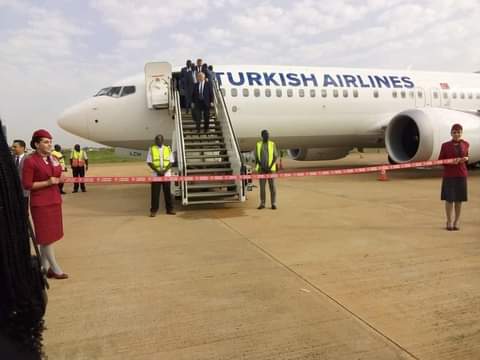
Turkish Airlines business analyst Ukkus, his well-trimmed grey suit swinging in the wind, slowly steps down the boarding stairs of the Boeing 737/800 Max plane, taking in the eager stairs from South Sudan and Turkish diplomats waiting on the Juba Airport runway. “Wow, this looks good,”Ukkus exclaims as he looks past the dozens of officials scrambling to set the ribbon for the VIPs to cut and steps into a sunny Wednesday. Is this his first time to South Sudan? “Yeah, and it feels good to be here on this historic occasion.”
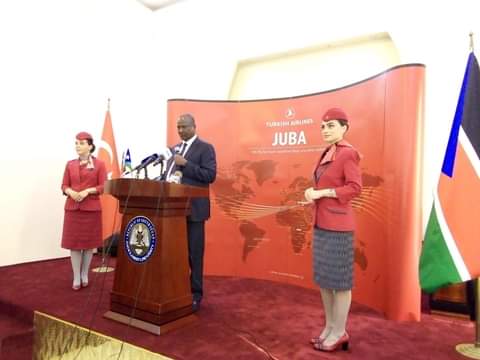
Vice President Taban Deng giving his speech

Turkish Airlines will fly three times a week to Istanbul from Juba, its 62nd destination in Africa, presenting an option for travellers and cargo, cementing Istanbul’s intent to become a competitive hub, and throwing back to the Turkish historical and cultural ties dating to the Turkish rule through Egypt’s khedives.

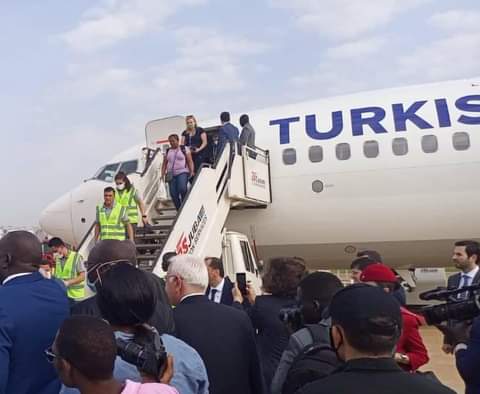
Moments before plane lands, officials on the ground expect the inaugural flight to circle the airport for some minutes before landing. The 151-seater 737/800 Max touches down directly without circling, giving officials little time to set up. Officials scramble to set up the ribbon while immigration agents whisk away passengers boarding or disembarking from other planes and attempting to witness the ribbon cutting. “We are used to flying in Africa,” the pilot Gokhan Ulu, tells TIMEOFTHEWORLD.COM as his co-pilot Abdullah Kayar watches. “It wasn’t much of a hustle for us because the landscape is more or less the same.”

Joining Ethiopian, Fly Dubai, and Egypt Air that indirectly ply the South Sudan-Turkey route, Turkish Airlines becomes the newest entrant into the South Sudanese skies. “These direct flights on Mondays, Wednesdays, and Fridays will ease the cargo challenges of the South Sudanese and Turkish business community and enhance cultural ties,” says Chief Executive Officer Bilal Ekşi, adding that Istanbul, the airline’s hub, bridges continents, cities, and people. Turkey is renowned for quality textiles. The Airline’s introductory fare of $520 (Juba-Istanbul) and $646 (Istanbul-Juba) is a source of optimism for small-scale traders.

In the bright blue interior of his boutique, Atak Dhieu, stops organizing his stock to take in the news. “When will the flights begin?” he asks TIMEOFTHEWORLD.COM. “This is excellent news; we won’t be losing any more money to intermediaries,” he says. “We used to be scared of the cost of the tickets to Istanbul – a situation that forced us to import goods through middlemen in Juba and Egypt,” he says, tightening his shoelace as if to make a statement that he is ready to travel immediately.

The optimistic welcome from small boutique owners, such as Dhieu, could portend a bright future for the airline. Turkish investors, too, are excited, according to the Turkish ambassador to South Sudan Erdem Mutaf. “The start of these direct flights has created a buzz of interest from Turkish investors due to the direct connection and reduced cost,” says Moutaf, adding that the flight would significantly benefit the international community.

Vice President Taban Deng Gai, who oversees the country’s infrastructure cluster,hints at just such an outcome. “We are at the centre of Africa, closer to the Eastern part of the Democratic Republic of Congo (DRC) and Central African Republic (CAR),” Gai says. “With the huge number of humanitarian organizations and the international community in the two countries, Juba will become the ideal connection hub for them to Europe through Turkish Airlines.”
According to Taban, Turkey and South Sudan have had rich cultural ties. “South Sudanese remembers the Turkish people as the people who introduced modern governance, civilization, and education,” Deng says. “This explains why there are still some old Turkish buildings in Juba. Hundreds of South Sudanese are called Turuk, (meaning Turkish), from the olden times.”

Turkish Airlines started operations on May 20, 1933, with five planes and fewer than 30 employees, a journey that continues today as the Airline flies to most countries in the world – celebrating its 89th year.Next for Turkish Airlines after Juba is the inaugural flight to Kotor and Tivat in Montenegro on June 11. The airline prides itself in its young and modern fleet, comfortable seats, delicious treats, and fleet of 376 that carries the Turkish flag to 120 countries across the globe.

- A word from our sponsors -

sponsored: GRE. GMAT. TOEFL. IELT CLASSESspot_img

Most Popular

More from section

More Courage Than Before: Female Monitors Strengthening Early Warning Systems in South Sudan

Simona Ali, an Early Warning Monitoring Fellow from Wau, says the fellowship created a space for female journalists to share experiences and learn from each other. By passing this knowledge on to colleagues in her newsroom, she is helping strengthen awareness of journalist safety and professional rights

Speaking Up for Rights: Female Monitors Strengthening Early Warning Systems in South Sudan

Catherine Adut, an Early Warning Monitoring Fellow from Lakes State, says the fellowship helped her understand her rights and speak up against unfair treatment. Today, she encourages other female journalists to report harassment, defend their rights, and support one another in the newsroom.

Confidence to Stand Up: Female Monitors Strengthening Early Warning Systems in South Sudan

Viola Nyoka, an Early Warning Monitoring Fellow from Yei, says the fellowship helped her understand the risks female journalists face and the importance of speaking up. Through shared experiences with colleagues across South Sudan, she gained the confidence to challenge exploitation, report harassment, and stand up for her rights in the newsroom.

Knowing Where to Turn: Female Monitors Strengthening Early Warning Systems in South Sudan

Vivian Nandege, an Early Warning Monitoring Fellow from Yei, says the fellowship helped her understand where to seek support when facing challenges in journalism. Through connections with other female journalists, she has gained confidence, shared knowledge, and built a stronger professional network.

- A word from our sponsors -

spot_img

Read Now

More Courage Than Before: Female Monitors Strengthening Early Warning Systems in South Sudan

Simona Ali, an Early Warning Monitoring Fellow from Wau, says the fellowship created a space for female journalists to share experiences and learn from each other. By passing this knowledge on to colleagues in her newsroom, she is helping strengthen awareness of journalist safety and professional rights

Speaking Up for Rights: Female Monitors Strengthening Early Warning Systems in South Sudan

Catherine Adut, an Early Warning Monitoring Fellow from Lakes State, says the fellowship helped her understand her rights and speak up against unfair treatment. Today, she encourages other female journalists to report harassment, defend their rights, and support one another in the newsroom.

Confidence to Stand Up: Female Monitors Strengthening Early Warning Systems in South Sudan

Viola Nyoka, an Early Warning Monitoring Fellow from Yei, says the fellowship helped her understand the risks female journalists face and the importance of speaking up. Through shared experiences with colleagues across South Sudan, she gained the confidence to challenge exploitation, report harassment, and stand up for her rights in the newsroom.

Knowing Where to Turn: Female Monitors Strengthening Early Warning Systems in South Sudan

Vivian Nandege, an Early Warning Monitoring Fellow from Yei, says the fellowship helped her understand where to seek support when facing challenges in journalism. Through connections with other female journalists, she has gained confidence, shared knowledge, and built a stronger professional network.

Strengthening Professional Networks: Female Monitors Strengthening Early Warning Systems in South Sudan

Cecilia John Akile, an Early Warning Monitoring Fellow from Wau, says the fellowship helped her build stronger professional connections with journalists across South Sudan. Through the network, she has learned the importance of speaking openly about challenges and collaborating with colleagues to find solutions

Standing Firm Under Pressure: Female Monitors Strengthening Early Warning Systems in South Sudan

Assunta Aluel, a journalist from Twic County, says the Monitoring Fellowship helped her remain calm and professional when she faced questioning after reporting a sensitive community story. The training equipped her with the confidence and knowledge to navigate pressure while continuing her work.

Building Stronger Connections: Female Monitors Strengthening Early Warning Systems in South Sudan

Aleng Vicky, an Early Warning Monitoring Fellow from Torit, says the fellowship helped female journalists across Eastern Equatoria connect and share experiences. Through new communication platforms and peer discussions, women journalists are building stronger networks and supporting each other in the profession.

From Connection to Courage: Female Monitors Strengthen Early Warning Systems in South Sudan

"At the back of your mind, when covering news, you must remember there are things you must follow while doing this. That has instilled more confidence in us than before." - ARICH DENG

Forging a Lifeline: Female Monitors Power Early Warning Systems in South Sudan

An early warning system fellowship empowers frontline monitoring fellows to detect risks early, trigger rapid response, and strengthen protection support for those facing threats.

The Mic Was Silenced: A Young Female Journalist Struggles to Reclaim the Airwaves in South Sudan

They shut it down after a song—just a traditional tune from the wrong community—played during a flare-up in local fighting. Officials stormed in, seized the keys, and warned the staff: One more mistake, and the whole station is gone for good. For a moment, Achol was jobless...

 “If You Don’t Have the Heart for It, You Can’t Carry On”

As a child, she fled bombings by the Sudanese government and attacks by the Ugandan rebel Lord’s Resistance Army, living a refugee live in DR-Congo, CAR, and Uganda. As a woman, she faced down militias. Today, she stands at the frontline of media freedom in Western Equatoria...