
“South Sudanese remember the Turkish people as the people who introduced modern governance, civilization, and education. This explains why there are still some old Turkish buildings in Juba. Hundreds of South Sudanese are called Turuk, (meaning Turkish), from the olden times.”
VICE PRESIDENT TABAN DENG GAI
By Richard Sultan
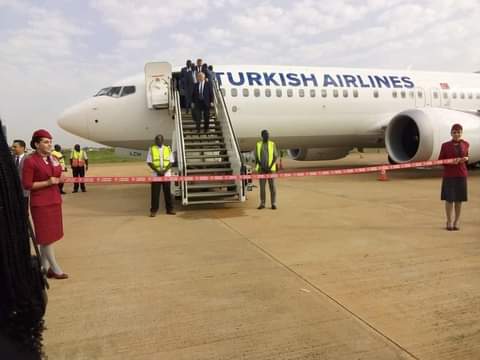
Turkish Airlines business analyst Ukkus, his well-trimmed grey suit swinging in the wind, slowly steps down the boarding stairs of the Boeing 737/800 Max plane, taking in the eager stairs from South Sudan and Turkish diplomats waiting on the Juba Airport runway. “Wow, this looks good,”Ukkus exclaims as he looks past the dozens of officials scrambling to set the ribbon for the VIPs to cut and steps into a sunny Wednesday. Is this his first time to South Sudan? “Yeah, and it feels good to be here on this historic occasion.”
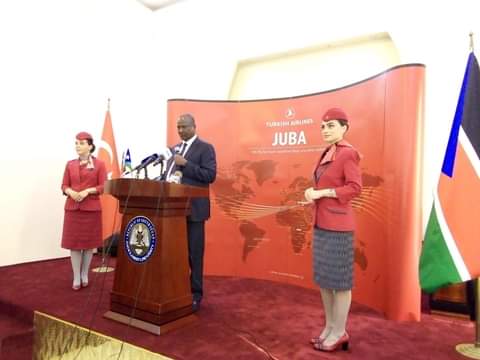
Vice President Taban Deng giving his speech
Turkish Airlines will fly three times a week to Istanbul from Juba, its 62nd destination in Africa, presenting an option for travellers and cargo, cementing Istanbul’s intent to become a competitive hub, and throwing back to the Turkish historical and cultural ties dating to the Turkish rule through Egypt’s khedives.
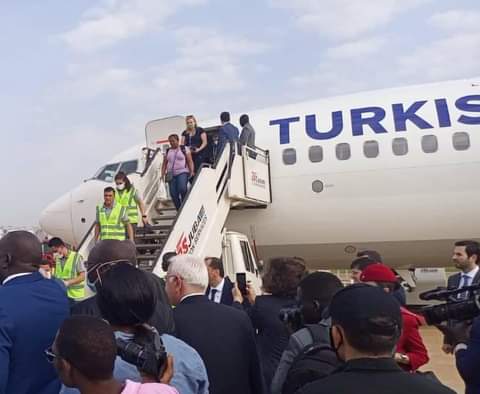
Moments before plane lands, officials on the ground expect the inaugural flight to circle the airport for some minutes before landing. The 151-seater 737/800 Max touches down directly without circling, giving officials little time to set up. Officials scramble to set up the ribbon while immigration agents whisk away passengers boarding or disembarking from other planes and attempting to witness the ribbon cutting. “We are used to flying in Africa,” the pilot Gokhan Ulu, tells TIMEOFTHEWORLD.COM as his co-pilot Abdullah Kayar watches. “It wasn’t much of a hustle for us because the landscape is more or less the same.”
Joining Ethiopian, Fly Dubai, and Egypt Air that indirectly ply the South Sudan-Turkey route, Turkish Airlines becomes the newest entrant into the South Sudanese skies. “These direct flights on Mondays, Wednesdays, and Fridays will ease the cargo challenges of the South Sudanese and Turkish business community and enhance cultural ties,” says Chief Executive Officer Bilal Ekşi, adding that Istanbul, the airline’s hub, bridges continents, cities, and people. Turkey is renowned for quality textiles. The Airline’s introductory fare of $520 (Juba-Istanbul) and $646 (Istanbul-Juba) is a source of optimism for small-scale traders.
In the bright blue interior of his boutique, Atak Dhieu, stops organizing his stock to take in the news. “When will the flights begin?” he asks TIMEOFTHEWORLD.COM. “This is excellent news; we won’t be losing any more money to intermediaries,” he says. “We used to be scared of the cost of the tickets to Istanbul – a situation that forced us to import goods through middlemen in Juba and Egypt,” he says, tightening his shoelace as if to make a statement that he is ready to travel immediately.
The optimistic welcome from small boutique owners, such as Dhieu, could portend a bright future for the airline. Turkish investors, too, are excited, according to the Turkish ambassador to South Sudan Erdem Mutaf. “The start of these direct flights has created a buzz of interest from Turkish investors due to the direct connection and reduced cost,” says Moutaf, adding that the flight would significantly benefit the international community.
Vice President Taban Deng Gai, who oversees the country’s infrastructure cluster,hints at just such an outcome. “We are at the centre of Africa, closer to the Eastern part of the Democratic Republic of Congo (DRC) and Central African Republic (CAR),” Gai says. “With the huge number of humanitarian organizations and the international community in the two countries, Juba will become the ideal connection hub for them to Europe through Turkish Airlines.”
According to Taban, Turkey and South Sudan have had rich cultural ties. “South Sudanese remembers the Turkish people as the people who introduced modern governance, civilization, and education,” Deng says. “This explains why there are still some old Turkish buildings in Juba. Hundreds of South Sudanese are called Turuk, (meaning Turkish), from the olden times.”
Turkish Airlines started operations on May 20, 1933, with five planes and fewer than 30 employees, a journey that continues today as the Airline flies to most countries in the world – celebrating its 89th year.Next for Turkish Airlines after Juba is the inaugural flight to Kotor and Tivat in Montenegro on June 11. The airline prides itself in its young and modern fleet, comfortable seats, delicious treats, and fleet of 376 that carries the Turkish flag to 120 countries across the globe.